


A widespread service disruption has crippled Microsoft’s Xbox Live network, leaving millions of players unable to access their games, including, critically, those purchased on physical discs. The escalating outage, which began affecting core services earlier on Monday, July 27th, 2026, has expanded beyond digital content to impact even offline-intended physical media and backward compatibility features, raising significant concerns about digital ownership and consumer access rights in the modern gaming ecosystem.
Unprecedented Disruption Grips Xbox Ecosystem
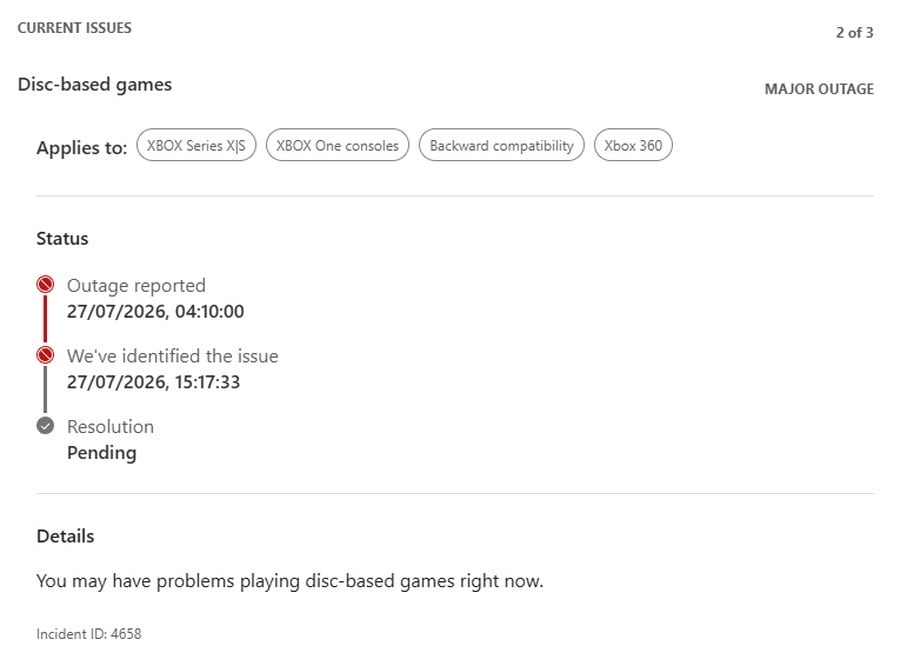
The latest update from the official Xbox Status page, timestamped Monday, July 27th, 2026, at 3:17 PM BST, confirmed a "Major Outage" affecting disc-based games and backward compatibility. This represents a significant escalation from earlier reports that primarily focused on digital game access and core account services. The official statement starkly warned: "You may have problems playing disc-based games right now." This development has sent ripples of concern through the gaming community, as it challenges the long-held assumption that physical media provides a reliable offline alternative to purely digital purchases, even on contemporary console platforms.
The current incident follows closely on the heels of a separate server outage just last week, which marred the highly anticipated early access launch of Halo: Campaign Evolved. That earlier disruption prevented players from accessing the game on its debut day, drawing criticism towards Team Green for service instability during critical launch periods. While the previous issue was eventually resolved, the recurrence and expansion of the current outage signal a deeper, more systemic challenge within the Xbox Live infrastructure.
A Chronology of Compounding Issues
The current service interruption began to manifest for users on Monday, July 27th, 2026, with initial reports indicating difficulties across several fundamental Xbox Live functions. Players globally reported issues signing into their Xbox accounts, finding their purchased digital games absent from their libraries, and experiencing outright failures when attempting to launch various titles.
- Early Monday, July 27th, 2026: Initial user complaints flooded social media platforms and support forums. Xbox Support on X (formerly Twitter) officially acknowledged the growing reports of an outage, indicating that engineers were actively investigating the issues. At this stage, the Xbox Status page detailed "Major Outage" alerts for critical services including "Account & Profile," "Store & Subscriptions," and "Apps & Mobile." This meant users couldn’t manage their profiles, make purchases, download new applications, or even reliably use existing mobile integrations.
- Monday, July 27th, 2026, 3:02 PM BST (Update #1): The situation deteriorated further as the Xbox Status page was updated to confirm that "Games & Gaming" was also suffering a major outage. This directly impacted the ability to play digital titles, with the official advisory stating: "You may have problems playing your digital games right now." This confirmation solidified the fears of many players who had been unable to access their digitally owned libraries.
- Monday, July 27th, 2026, 3:17 PM BST (Update #2): The most severe escalation occurred with the subsequent update. The Xbox Status page explicitly added disc-based games and backward compatibility to the list of affected services, citing a "Major Outage." The direct consequence was that even players inserting physical game discs into their consoles were being prevented from launching or playing their titles, alongside issues with accessing the extensive library of backward-compatible games from previous Xbox generations. This revelation underscored the profound reliance of even physical media on online server verification for modern console functionality.
The Technical Nexus: Why Discs Need Servers
The inability to play disc-based games during a server outage is a phenomenon that often surprises and frustrates consumers, who traditionally associate physical media with offline autonomy. However, modern gaming consoles, including the Xbox Series X|S and Xbox One, have integrated several online checks into their operational protocols, even for disc-based titles.
- Digital Rights Management (DRM) Verification: Many contemporary games, even when purchased physically, include DRM measures that require an initial online check to verify the legitimacy of the game disc and the user’s license. This is designed to combat piracy and ensure compliance with licensing agreements. Without access to Xbox Live servers, these verification processes fail, effectively locking players out of their games.
- Mandatory Updates and Installations: While a game disc contains core data, almost all modern titles require significant day-one patches, updates, or even partial installations from online servers to be fully playable. If Xbox Live is down, these crucial downloads cannot occur, leaving the game unplayable or stuck in an incomplete state.
- Backward Compatibility: Xbox’s robust backward compatibility program relies heavily on server-side authentication and digital emulation layers. When a player inserts an Xbox 360 or original Xbox disc, the console often downloads a specific digital version or emulator profile for that game from Xbox Live. This ensures optimal performance and compatibility. A server outage directly severs this link, rendering backward-compatible titles inaccessible.
- Profile and Save Data Synchronization: Even for offline play, user profiles, achievements, and cloud save data are often linked to Xbox Live. While some games might allow limited offline play, a complete server outage can prevent the console from authenticating the user’s profile, leading to issues with game launching or progress saving.
These interdependencies highlight a fundamental shift in gaming, where the line between physical and digital ownership has blurred significantly, with both often tethered to the availability and stability of online services.
Scale and Impact on the Global Gaming Community

Microsoft’s Xbox platform boasts a massive global user base, with tens of millions of active players and Xbox Game Pass subscribers worldwide. While specific numbers on affected users during this outage are not immediately available, the sheer breadth of the services impacted—from account sign-ins and store access to the fundamental ability to launch games, both digital and physical—suggests a disruption affecting a substantial portion of the Xbox community.
The timing of the outage, occurring on a Monday, typically a workday, might mitigate some immediate recreational impact compared to a weekend. However, for those using their downtime or working remotely, the inability to access entertainment or even social features on Xbox Live is a significant inconvenience. Furthermore, the disruption to the "Store & Subscriptions" category means that potential revenue from new game sales, DLC purchases, or Game Pass subscriptions is temporarily halted, impacting Microsoft’s financial operations and potentially affecting developers whose games are featured on the platform. The cumulative effect of multiple outages in quick succession also chips away at consumer confidence, particularly for those considering a full transition to digital-only ecosystems.
User Frustration and the Digital Ownership Debate
The reaction from the Xbox community has been one of significant frustration, amplified by the fact that even physical games are rendered unplayable. Social media platforms like X (formerly Twitter), Reddit, and various gaming forums are replete with user complaints, reports of failed login attempts, and expressions of disbelief regarding the server’s impact on disc-based titles. Many users are questioning the value proposition of owning physical media if its functionality is contingent on external servers.
This outage reignites the perennial debate surrounding "digital ownership" in the modern era. When a consumer purchases a digital game, they often acquire a license to play it, rather than outright ownership of the software itself. This license is typically tied to an online account and validated by platform servers. The current outage starkly illustrates the vulnerability of this model: if the servers go down, the "owned" content becomes inaccessible.
The extension of this vulnerability to physical discs further complicates the issue. Historically, physical media was seen as a bulwark against such issues, offering a tangible copy that could theoretically be played indefinitely, regardless of server status. However, with modern console architecture, mandatory online checks, and significant day-one patches, even physical ownership is increasingly intertwined with the health of online services. This raises fundamental questions about consumer rights, game preservation, and the long-term viability of content access if platform holders cease support or experience prolonged technical failures.
Official Responses and Ongoing Remediation
Throughout the unfolding crisis, Xbox Support has maintained a degree of transparency by regularly updating its official Xbox Status page and communicating via its social media channels. While the updates confirm the severity and scope of the issues, they typically do not delve into the underlying causes of the outage. The standard message indicates that "Xbox engineers are working to fix the issues," a common phrase during such disruptions.
The lack of detailed technical explanations, while understandable from a public relations standpoint, can add to user anxiety. However, the consistent updates provide a centralized point of information for affected users. In previous outages, Microsoft has typically resolved such widespread issues within several hours to a day, deploying hotfixes and restoring server functionality incrementally. The current challenge lies in the multifaceted nature of the outage, affecting a broad spectrum of services simultaneously, which may complicate the resolution process. The focus of remediation efforts will likely be on restoring core authentication services, database integrity, and network stability to bring all affected Xbox Live components back online.
Looking Ahead: Enhancing Resilience and Reassuring Consumers
The repeated and escalating nature of recent Xbox Live outages underscores the critical need for robust, redundant server infrastructure and potentially more resilient offline modes for core game functionality. While "always-online" requirements or initial online checks are often justified for security, anti-piracy, and update delivery, incidents like this force a re-evaluation of the balance between these operational necessities and consumer access.
Moving forward, platform holders like Microsoft may need to explore enhanced offline play options, particularly for disc-based games that should theoretically offer more autonomy. This could involve more comprehensive local license verification mechanisms or dedicated offline modes that require fewer server pings. Furthermore, greater transparency regarding the technical reasons behind outages and the steps being taken to prevent future occurrences could help rebuild consumer trust.
As the Xbox engineering teams continue their efforts to restore full service, millions of players worldwide remain in limbo, unable to access their purchased games. The ongoing outage serves as a potent reminder of the inherent vulnerabilities in a gaming landscape increasingly reliant on persistent online connectivity, prompting a renewed conversation about the true meaning of ownership in the digital age. The gaming community, eager to return to their virtual worlds, will be closely watching for a swift resolution and assurances of improved stability in the future.