


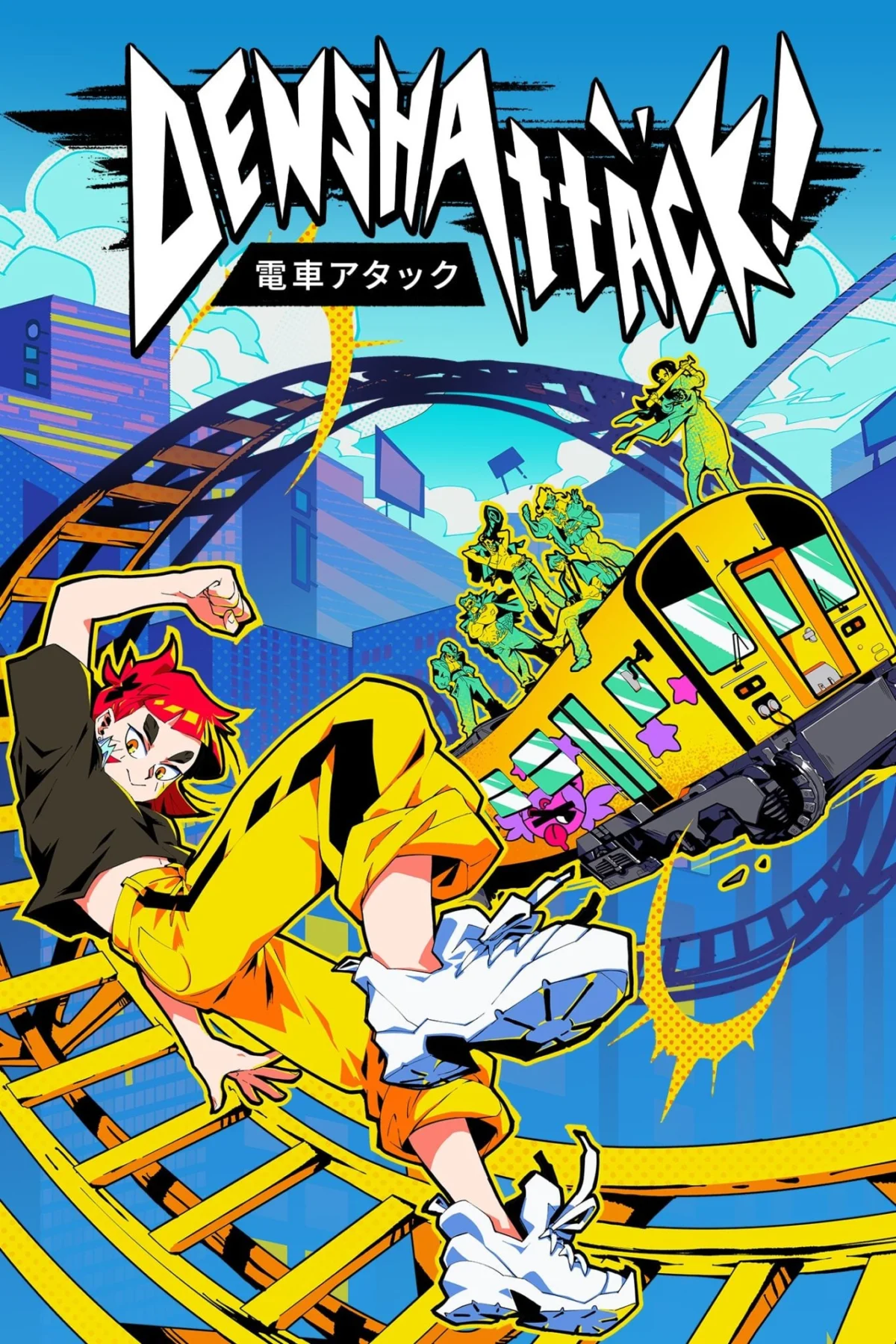
Denshattack! represents a significant genre-blending experiment in the modern gaming landscape, merging the high-speed kineticism of extreme sports titles like Tony Hawk’s Pro Skater with the structured combat and world-building of an action-adventure narrative. Developed by the Spanish studio Undercoders and published by Fireshine Games, the title is positioned as a major multi-platform release, arriving on the Nintendo Switch 2, PlayStation 5, and Steam, while also securing a Day One launch status on the Xbox Game Pass service. Set against the backdrop of a visually striking, climate-catastrophized future Japan, the game challenges players to navigate a complex socio-political landscape using nothing but modified trains and an array of gravity-defying maneuvers.

Narrative Framework and Environmental Context
The story of Denshattack! centers on Emi, a protagonist initially presented as a standard delivery driver tasked with transporting ramen to a character named Fernando. This mundane introduction serves as a gateway into the underground world of "Denshattack," a high-stakes sport and combat discipline that utilizes the nation’s sprawling railway infrastructure. Fernando, recognizing Emi’s latent potential and technical proficiency on the rails, serves as a mentor figure, introducing her to the competitive circuit and the broader resistance movement.
The setting is a "not-hellish" but distinctly altered Japan, where a historical climate catastrophe has fundamentally restructured human civilization. This version of the future is characterized by extreme class stratification, manifested physically through the existence of "domed cities." These high-tech enclaves house the global elite and are managed by the Maraido Corporation, a pervasive industrial entity symbolized by a seemingly innocuous mole mascot. Outside these domes, the remainder of the population, including Emi and the "Denshattackers," lives in the "nature" that remains, constantly under the surveillance and pressure of Maraido’s private police force.

Across nine distinct narrative chapters, Emi’s journey evolves from simple competition to corporate sabotage. The narrative relies heavily on the "power of friendship" trope, but applies it through a mechanical lens; Emi’s progression is tied to the specialized skills she learns from her companions. These include the ability to visualize "hidden rainbow tracks," navigate through thermal vents for aerial traversal, and unlock advanced machinery capable of rivaling the Maraido Corporation’s military-grade hardware.
Technical Gameplay Systems and Mechanics
At its core, Denshattack! is a trick-based racer that prioritizes momentum and precision. The game’s physics engine deliberately eschews realism in favor of player responsiveness and "game feel." Each level begins with a traditional countdown sequence, after which the player’s train remains in constant forward motion.

The control scheme is multifaceted, introducing a high volume of systems across the 12-to-30-hour experience:
- Braking and Speed Management: While the train moves automatically, the left trigger controls the brake. A "sweet spot" mechanic exists within the brake meter; if a player releases the brake at the precise midpoint while rounding a corner, they receive a substantial speed boost.
- Trick Execution: Using the right analog stick, players can perform various flips and rotations while airborne. These are combined with rail-grinding and wall-driving mechanics to maintain score multipliers.
- Movement and Gravity: The left stick handles track-hopping, allowing players to switch between parallel rails. Later levels introduce magnetic gravity transfers and cross-track boost pads, requiring rapid-fire decision-making.
- Combat and Mini-games: Boss encounters shift the gameplay from pure racing to hybrid combat scenarios, often incorporating unique mini-games that test the player’s mastery of the specific mechanics introduced in that chapter.
The game utilizes a tiered reward system, granting Bronze, Silver, and Gold medals based on three primary criteria: trick score, completion time, and "dares" (specific in-level challenges). For casual players, the main story can be concluded in approximately 12 hours, but completionists aiming for 100% across all tracks and difficulty spikes can expect a runtime exceeding 20 to 30 hours.

Visual Identity and Technical Performance
Denshattack! adopts a neon-soaked, cel-shaded aesthetic that draws heavy inspiration from the SEGA Dreamcast era, specifically echoing titles like Jet Set Radio. The environmental design features a "painterly" quality, with high-contrast colors that emphasize the futuristic urban and reclaimed natural landscapes of Japan.
Technically, the game is optimized for high-performance hardware. Testing on the ASUS ROG Ally X (utilizing an Xbox-on-PC environment) indicates that the game can achieve frame rates exceeding 100fps at medium settings. While the environments and train models are praised for their detail, the in-game character models have been described as resembling "paper cutouts," creating a stylistic dissonance with the high-quality hand-drawn portraits used during dialogue sequences and cutscenes.

The soundtrack is a high-tempo fusion of electronic and J-pop influences, designed to maintain the "flow state" required for high-level play. Furthermore, the game features full voice acting in both English and Japanese, reflecting its global development roots and its thematic focus on a multicultural future Japan. The inclusion of a diverse, international cast within a Japanese setting has been noted as a modern reimagining of the region’s cultural landscape.
Progression, Collectibles, and Customization
To encourage replayability, Undercoders has implemented a robust collectible system centered on "fan-zines." Players can discover several types of items hidden within tracks:

- Spray Paint Cans: These serve as the primary currency for cosmetic customization, allowing players to purchase stickers and decals for their trains.
- Film Rolls: Collected for Fernando, these rolls are used to "develop" fanzines that provide additional lore and context for each specific region of the map.
- Train Cogs: These are essential for mechanical progression. Players can deliver cogs to a pair of engineer brothers who craft new train models.
The train customization system is not purely aesthetic. Different models carry distinct "pros and cons." For instance, certain trains may feature a "magnetic grind" property that prevents the player from falling off rails, but at the cost of reduced scoring potential. This introduces a strategic layer to the game, as players must choose the appropriate equipment based on whether they are aiming for a high score or a fast completion time.
Market Positioning and Industry Implications
The release of Denshattack! arrives at a time when "arcade-style" revivals are gaining traction in the indie and AA sectors. By combining the niche appeal of train simulation (a popular genre in Japan) with the global popularity of extreme sports mechanics, Fireshine Games is targeting a broad demographic. The Day One inclusion on Xbox Game Pass is a strategic move to lower the barrier to entry for a title that features a potentially "overwhelming" number of gameplay systems.

Industry analysts suggest that the game’s success will depend on how players respond to its high "cognitive load." The reviewer’s experience—noting that the game can be "exhausting" to play for extended periods due to the intensity of the mechanics—highlights a trend in modern gaming where "flow state" experiences are pushed to their limits. Similar to the high-skill ceiling found in Titanfall 2 or OlliOlli World, Denshattack! demands significant mental engagement, making it a "damned fun" but taxing experience.
Chronology of Development and Release
- Initial Concept: Development began in Spain by Undercoders, seeking to bridge Western extreme sports gameplay with Eastern aesthetic influences.
- Publisher Partnership: Fireshine Games (formerly Sold Out) signed the title for global distribution, emphasizing a multi-platform strategy.
- Pre-Release Phase: The game underwent extensive testing on handheld PC hardware (like the Steam Deck and ROG Ally) to ensure performance parity with home consoles.
- Launch: Released in July 2026 across PC, PS5, and the new Nintendo Switch 2 hardware, alongside its debut on Xbox Game Pass.
Conclusion: The Final Verdict
Denshattack! is a bold, if occasionally chaotic, addition to the action-racing genre. It successfully leverages nostalgia for the Dreamcast era while providing a modern, socially conscious narrative regarding climate change and corporate overreach. While the sheer density of its mechanics may prove a hurdle for some, its vibrant world-building, rewarding progression system, and high-performance technical foundation make it a standout title for the 2026 summer season. Whether players are seeking a deep dive into lore-filled fanzines or a high-speed test of reflexes, Denshattack! offers a unique rail-bound journey that proves the "power of friendship" is best delivered at 200 miles per hour.