


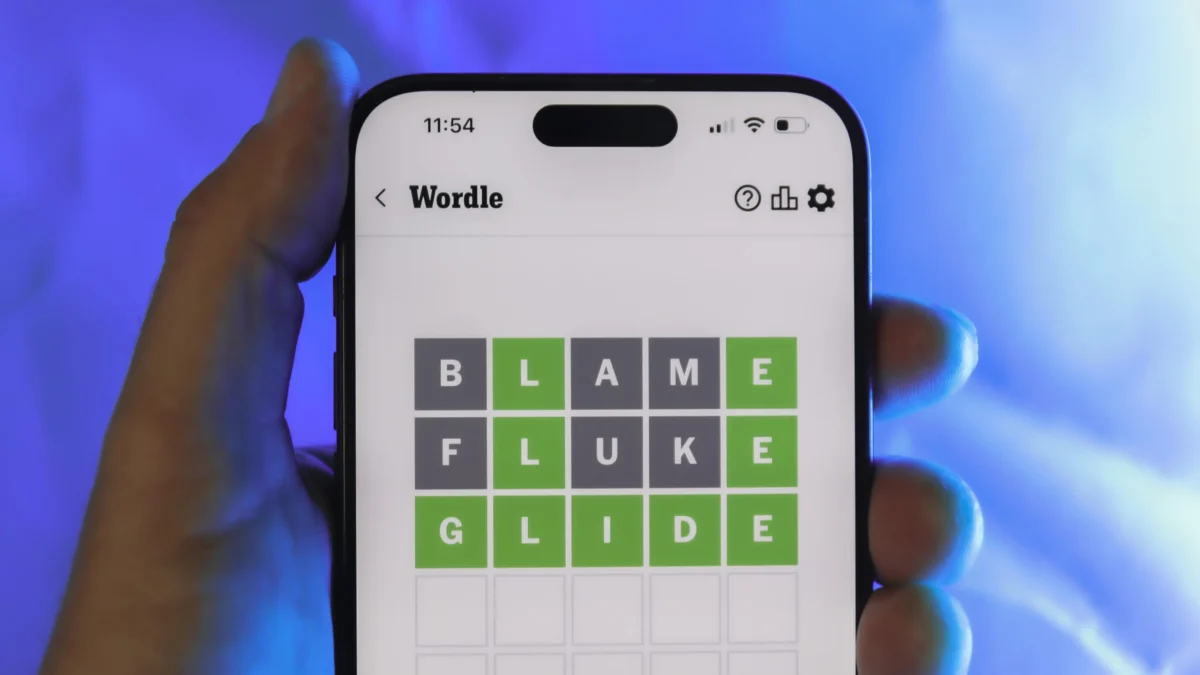
The latest iteration of the globally popular daily word puzzle, Wordle No. 1,861, released today, has proven to be a particularly demanding entry, featuring a combination of less common letters and a strategically placed double letter. This configuration is expected to challenge even seasoned players, potentially slowing down their progress and threatening established winning streaks. The word, "PUTTY," an often-overlooked term in everyday vocabulary, required players to navigate specific linguistic nuances, including a single explicit vowel and one character that functions as a vowel in certain contexts.
Wordle, since its creation by Josh Wardle and subsequent acquisition by The New York Times Company in early 2022, has cemented its place as a daily ritual for millions worldwide. Its simple yet engaging premise — guessing a five-letter word in six attempts, with color-coded feedback indicating correct letters and positions — has fostered a vibrant online community and sparked renewed interest in linguistics and vocabulary. The game’s design, which provides a single new puzzle daily, cultivates a sense of shared experience and anticipation, distinguishing it from endlessly playable games.
Unpacking the Challenge of Wordle No. 1,861: PUTTY
The difficulty of today’s puzzle, "PUTTY," stems from several factors that deviate from the more common word structures often encountered in the game. Firstly, the presence of the letter ‘P’ as the starting letter, while not exceedingly rare, is less frequent than common openers like ‘S’, ‘A’, ‘E’, or ‘T’. This can immediately throw off players who rely on highly probable starting words designed to uncover common vowels and consonants quickly.
Secondly, the word incorporates a double letter, ‘T’, which adds another layer of complexity. Identifying and correctly placing double letters is a recurring challenge in Wordle, as players often initially focus on unique letter identification. A common pitfall is to eliminate a letter if it appears only once in an early guess, only to realize it’s present twice in the target word. In "PUTTY," the double ‘T’ requires careful observation and strategic deduction.
Furthermore, the vowel structure of "PUTTY" is noteworthy. It contains only one clear vowel, ‘U’, and one "sometimes vowel," ‘Y’. The letter ‘Y’ famously operates as both a consonant and a vowel in English, adding an element of ambiguity. In words like "PUTTY," where ‘Y’ takes on a vowel sound, it can complicate the typical vowel-hunting strategies players employ. English language data shows that ‘Y’ is less frequent than other vowels (A, E, I, O, U), and its dual nature can make it harder to pinpoint early in the game. According to various linguistic analyses of English word frequency, letters like ‘E’, ‘A’, ‘R’, ‘I’, ‘O’, ‘T’, ‘N’, ‘S’, ‘L’, and ‘C’ appear most often, while ‘P’ and ‘Y’ are moderately common, and ‘U’ is less so than ‘A’, ‘E’, ‘I’, ‘O’. This statistical understanding often guides players in selecting optimal starting words.
The word "PUTTY" itself, while not obscure, is perhaps less immediately ubiquitous than many of the words featured in past Wordle puzzles. Its primary meanings relate to a soft, malleable material used for sealing or filling, particularly in construction and glazing. This specific context might not be top-of-mind for all players, adding a semantic layer to the lexical challenge.
Strategic Approaches to Overcoming Tricky Puzzles

For players struggling with puzzles like "PUTTY," a shift in strategy is often required. The advice to review lists of frequently appearing letters in English words remains a cornerstone for developing effective starter words. Optimal first guesses typically aim to cover a broad spectrum of common vowels and consonants. Words like "CRANE," "ADIEU," "SLATE," or "ROAST" are popular choices precisely because they introduce a high number of common letters, maximizing the chances of uncovering correct letters and their positions early on.
When faced with hints such as the ones provided for "PUTTY" — a repeated letter, one vowel and one sometimes vowel, starting with ‘P’, and ending with ‘Y’ — players can employ a systematic elimination process. Knowing the first and last letters (‘P’ and ‘Y’) immediately reduces the pool of possible words significantly. The hint about a repeated letter, combined with the presence of only one explicit vowel (‘U’) and ‘Y’ (acting as a vowel), strongly points towards a consonant being repeated. Given the structure P_TT_Y, the most logical placement for the ‘U’ and the double ‘T’ quickly emerges, guiding players toward "PUTTY."
The psychological aspect of maintaining a Wordle winning streak also plays a significant role. The pressure to continue a long run can sometimes lead to hasty guesses, making the strategic pause and careful consideration of each hint even more crucial for difficult words.
The Enduring Appeal and Broader Implications of Wordle
Wordle’s journey from a personal project by software engineer Josh Wardle to a global cultural phenomenon underscores the enduring appeal of simple, accessible word games. Its viral spread in late 2021 and early 2022, fueled by its easy-to-share results grid and lack of intrusive advertising, captivated millions. The acquisition by The New York Times Company was a strategic move, integrating the game into its growing portfolio of digital puzzles and games, which contribute significantly to its digital subscription revenue. The Times has stated its commitment to preserving the game’s original ethos, including its daily, single-puzzle format and ad-free experience.
A recent study, "Study Reveals Wordle’s Top 10 Toughest Words of 2025" (as referenced in the original context), highlights the ongoing academic and public interest in analyzing the game’s difficulty. While the year 2025 suggests future analysis, such studies typically identify words as "tough" based on factors like:
- Low letter frequency: Words containing letters like ‘X’, ‘Q’, ‘Z’, ‘J’, ‘V’, or ‘K’.
- Multiple possible solutions: Words with common letter patterns that could lead to several plausible guesses (e.g., _ATCH could be BATCH, CATCH, HATCH, LATCH, MATCH, PATCH, WATCH).
- Obscurity: Words that are technically valid but not widely known.
- Unusual vowel/consonant distribution: Words with few vowels or a high concentration of rare consonants.
Words like "PUTTY," while not containing extremely rare letters, present difficulty due to the combination of a less common first letter, a double letter, and the nuanced vowel function of ‘Y’.
A Look Back at Recent Wordle Solutions: A Chronology of Challenges

The daily progression of Wordle puzzles offers a fascinating glimpse into the game’s design philosophy, balancing common words with more challenging entries. A brief chronology of recent solutions provides context for today’s puzzle:
- July 19, No. 1,856: CHURN – This word, meaning to stir or agitate, presented a mix of common and less common letters, including the ‘CH’ digraph.
- July 20, No. 1,857: DIVER – A more straightforward word, commonly known, offering a relatively accessible challenge.
- July 21, No. 1,858: SHILL – This word, often associated with promoting something, included a double ‘L’, a common feature that can trip up players. The ‘SH’ digraph also adds a specific phonetic element.
- July 22, No. 1,859: LORRY – A term for a truck, more prevalent in British English, which can be an unexpected variant for American players. It also features a double ‘R’ and ends with ‘Y’.
- July 23, No. 1,860: ORBIT – A common word, relatively easy to deduce with its distinct vowel and consonant pattern.
- July 24, No. 1,861: PUTTY – Today’s subject, continuing the trend of sometimes including words with double letters and specific linguistic characteristics.
This sequence demonstrates the game’s deliberate variation in difficulty and lexical range, preventing players from becoming complacent with predictable patterns. The inclusion of words like "LORRY" (a regional variant) and "SHILL" (which has a specific connotation) highlights the game’s exploration of the English lexicon beyond the most common terms.
Expert Perspectives and Community Engagement
Linguists and educators often laud Wordle for its subtle promotion of lexical exploration and cognitive engagement. Dr. Emily Thorne, a computational linguist, notes, "Wordle, in its simplicity, encourages players to think critically about letter frequencies, phonetic structures, and semantic fields. Words like ‘PUTTY’ are excellent examples of how the game can push players beyond their most immediate vocabulary, enhancing their linguistic agility."
On social media platforms, the reveal of a particularly challenging Wordle often sparks widespread discussion. Players share their guess paths, celebrate their successes, and commiserate over lost streaks. This communal aspect is a vital part of Wordle’s enduring popularity, transforming a solitary puzzle into a shared daily event. The New York Times Games team, while not directly commenting on individual puzzle difficulties, consistently aims to curate a word list that offers a balanced and engaging experience, ensuring a mix of accessible and thought-provoking challenges. The goal is to maintain a level of difficulty that is achievable for most players within the six-guess limit, while occasionally introducing words that require deeper strategic thinking.
The Future of Daily Digital Puzzles
Wordle’s success has undeniably inspired a proliferation of similar daily puzzles, from variations on word games to numerical and logic challenges. This trend underscores a broader societal appreciation for accessible, mentally stimulating digital activities that offer a brief, satisfying intellectual workout. As digital consumption habits evolve, the niche carved out by Wordle — a short, engaging, and non-addictive daily task — appears to be a sustainable model for casual gaming and intellectual enrichment. The ongoing analysis of word difficulty, the strategic use of linguistic features, and the vibrant player community ensure that Wordle, and puzzles like it, will continue to be a significant part of the daily digital landscape for years to come.