



The gaming landscape continues to evolve with the introduction of new hardware designed to offer unparalleled flexibility and power to players. In a significant move for the portable PC gaming market, Microsoft has collaborated with ASUS Republic of Gamers (ROG) to bring the ROG Ally, a branded handheld gaming PC, to market. Officially launching tomorrow, this device aims to blend the convenience of a handheld with the robust capabilities of a PC, particularly for those invested in the Xbox ecosystem. However, the question remains: is the ROG Ally a worthwhile investment for the discerning gamer?
Unveiling the ROG Ally: A Hands-On First Look
A recent hands-on event in Manhattan provided an early glimpse into the capabilities of both the standard ROG Ally and its more powerful iteration, the ROG Ally X. While both devices present compelling arguments for handheld PC gaming, the enhanced ROG Ally X garnered particular attention for its substantial upgrades. This evaluation, conducted by a reviewer with prior experience on the Steam Deck and Nintendo Switch 2, suggests that the ROG Ally X is positioned as a premium option for dedicated PC handheld enthusiasts, while the base model offers a more accessible entry point.
The initial impressions of the ROG Ally X highlight its surprisingly lightweight construction relative to its internal power. Ergonomically, the device has been praised for its comfort, drawing parallels to the familiar feel of an Xbox controller. The grooved grips are designed to mimic the contours of a traditional Xbox gamepad, creating an experience that feels like holding a familiar controller, albeit with a prominent display at its center. This design philosophy appears geared towards facilitating extended gaming sessions without the discomfort or hand cramps that can sometimes plague other handheld consoles, such as the Nintendo Switch 2.
Performance and Battery Life: A Tale of Two Modes
The performance differential between the ROG Ally X and its standard counterpart is a key consideration for potential buyers. For users already familiar with devices like the Steam Deck, the ROG Ally X reportedly offers a discernible leap in processing power. This increased performance allows for the seamless execution of demanding titles like Gears of War: Reloaded and Doom: The Dark Ages at high fidelity and smooth frame rates.

Conversely, the standard ROG Ally’s performance, when running games, is described as being more in line with the Steam Deck’s capabilities. While this might be sufficient for many, the ROG Ally X’s enhanced power is what truly sets it apart.
A significant factor in handheld gaming is battery life. The ROG Ally models feature adjustable wattage settings, allowing users to balance graphical performance with power consumption. Lowering the wattage can extend battery life considerably, though it comes at the cost of reduced graphical quality and overall game performance. For maximum performance, connecting the device to a power supply is recommended. This reliance on external power for peak performance may be a consideration for gamers who prioritize portability and extended unplugged play. The optimal balance between performance and battery life will likely be a primary decision point for consumers.
The ROG Ally X: A Premium Choice for Enthusiasts
The ROG Ally X, in particular, appears to justify its elevated price point through significant internal enhancements. It boasts a more powerful CPU, an improved battery, and increased RAM compared to the base model. These upgrades position the ROG Ally X as the device of choice for dedicated and hardcore gamers seeking the utmost in handheld PC gaming performance. The base ROG Ally, on the other hand, is positioned as an entry-level option, particularly appealing to console gamers looking to transition into the PC handheld space, especially those with existing Xbox libraries.
Physically, the differences between the two models are subtle, primarily distinguished by color and a slight weight increase in the ROG Ally X. This suggests that ASUS has focused its development efforts on internal hardware and battery improvements rather than radical design overhauls between the two versions.
Bridging the Console and PC Divide: The Xbox Integration
A major selling point for the ROG Ally series is its deep integration with the Xbox ecosystem. The user interface, controls, and overall device navigation are designed to be immediately familiar to Xbox users. The UI closely mirrors that of the Xbox Series X and Series S, featuring dedicated tabs for Game Pass, the Xbox Store, Cloud Gaming, and a library section for organized game access. This seamless integration aims to lower the barrier to entry for Xbox players looking to explore PC gaming on a portable device.
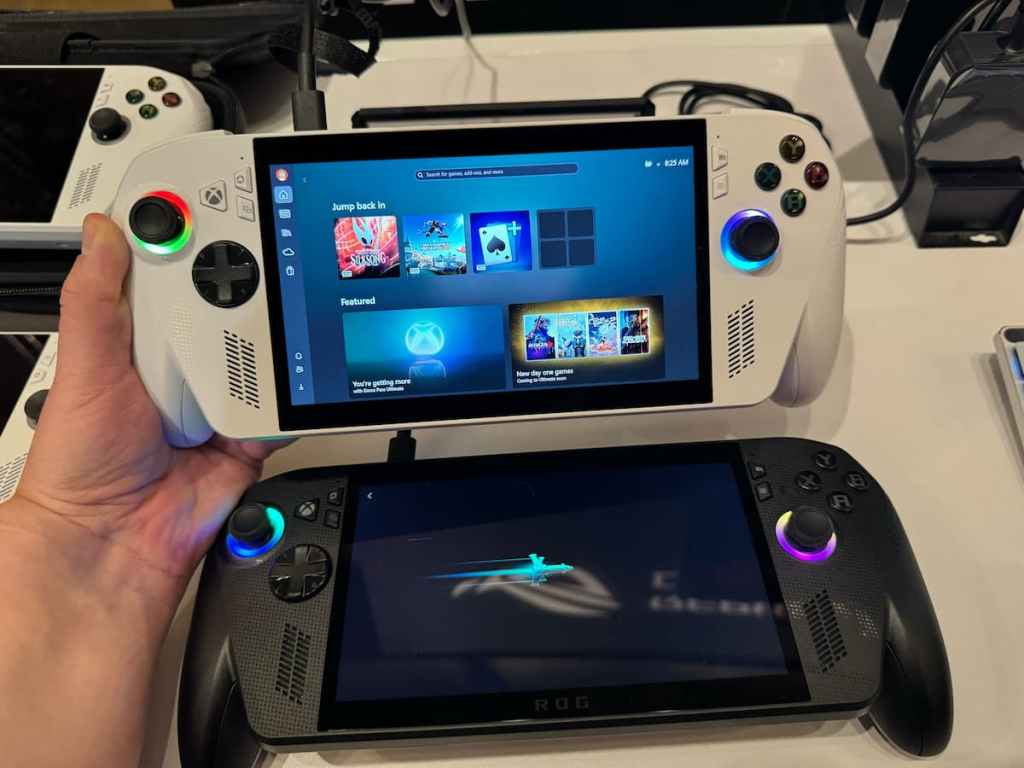
Beyond the Xbox ecosystem, both ROG Ally models support multiple PC game libraries, including Steam, Epic Games Store, GOG, and others. This broad compatibility allows users to access and play their existing digital game collections on the go. Furthermore, cloud streaming services like Game Pass enhance the device’s versatility, offering access to an even wider array of titles. For PC gamers with extensive libraries across various platforms, the ROG Ally presents an enticing proposition, consolidating their gaming experiences onto a single, portable device.
The Handheld Compatibility Program: Enhancing User Experience
A notable new feature introduced with the ROG Ally is the Handheld Compatibility Program. Functioning similarly to Steam Deck’s Verified system, this program provides users with clear indicators of a PC game’s compatibility with the ROG Ally. This system allows players to quickly assess the ease or difficulty of playing a particular game on the handheld, thereby streamlining the selection process and potentially attracting new users to the handheld PC gaming environment. This initiative demonstrates a commitment to refining the user experience and making PC gaming more accessible.
Intuitive Controls and Display Technology
Ease of use is further emphasized by the intuitive menu navigation across both ROG Ally models. The Xbox guide button, located on the top left of the device, serves as the primary access point for a sub-menu. From this menu, users can adjust critical settings, including switching between handheld and desktop control modes, and most importantly, modifying the Operating Mode. This setting directly controls the device’s power consumption and performance levels.
The display technology employed in both handhelds is a shared strength. Both models feature a 120Hz refresh rate, 500 nits of brightness, and AMD Variable Refresh Rate (VRR) technology, promising a visually impressive and smooth gaming experience. The audio capabilities are also noteworthy, with loud, clear speakers that were tested in a noisy environment, maintaining sound quality amidst distractions. This attention to display and audio quality underscores ASUS’s commitment to delivering a premium handheld gaming experience.
Market Positioning and Future Implications
The decision to invest in a handheld gaming PC like the ROG Ally X, especially with a price point potentially around $1,000, is a significant one. However, for dedicated gaming enthusiasts with the requisite budget, the ROG Ally X presents a compelling option, particularly given the anticipated longer development cycle for a successor to Valve’s Steam Deck.

For consumers seeking a more budget-friendly entry into expanded Xbox gaming capabilities on a handheld, the standard ROG Ally remains a viable alternative. This tiered product strategy allows Microsoft and ASUS to cater to a broader spectrum of the gaming market, from casual players to the most demanding enthusiasts.
The broader implications of this partnership extend to the continued growth of the handheld PC gaming sector. By leveraging Microsoft’s software ecosystem and ASUS’s hardware expertise, the ROG Ally devices are poised to challenge existing market leaders and further legitimize portable PC gaming as a mainstream entertainment option. The focus on user experience, compatibility, and performance suggests a strategic effort to capture a significant share of this expanding market. As the technology matures and prices potentially decrease over time, devices like the ROG Ally could redefine how and where gamers access their favorite titles. The availability of robust gaming experiences on a portable, PC-based platform opens up new possibilities for both casual and hardcore players alike, blurring the lines between traditional console gaming and PC gaming.