


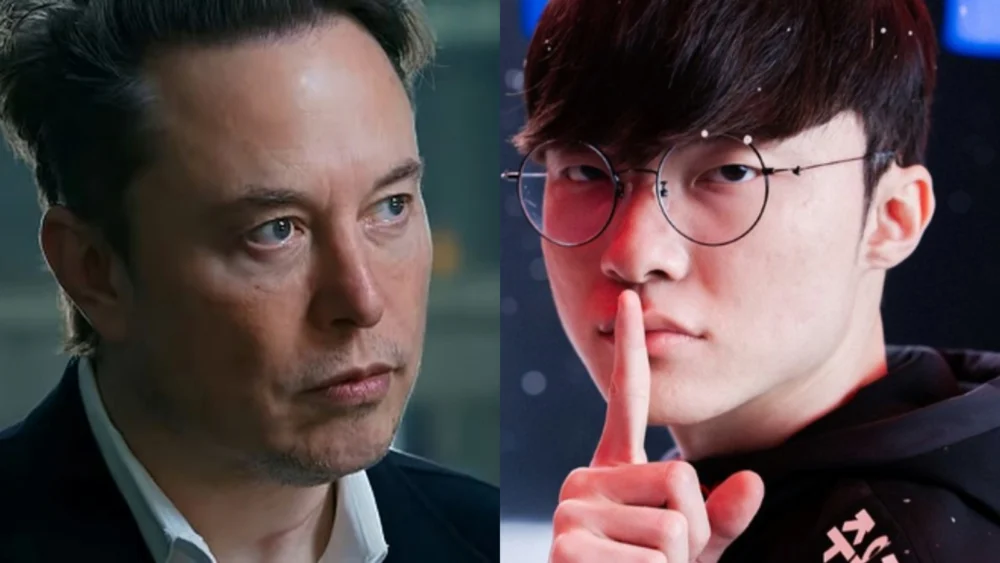
The esports world is abuzz with the groundbreaking announcement that T1, widely recognized as the premier League of Legends team, and its legendary mid-laner Lee "Faker" Sang-hyeok, have accepted a direct challenge from tech mogul Elon Musk to compete against his advanced artificial intelligence, Grok. This unprecedented confrontation, slated for 2026, positions Grok as a potential AI challenger to the pinnacle of human strategic gaming prowess, drawing parallels to historical man-vs-machine intellectual duels.
Elon Musk’s ambitious foray into artificial intelligence, particularly with his conversational AI Grok, has increasingly focused on its potential to revolutionize the gaming industry. Musk has publicly articulated a vision where AI could not only contribute to game development but potentially create entire gaming experiences independently. His venture into establishing an AI game studio signals a serious commitment to this frontier, with predictions that AI could be capable of generating a complete video game by 2029. The proposed match against T1 and Faker represents a significant intermediate step in this grander AI gaming ambition, aiming to test the current capabilities of Grok in a highly complex, real-time competitive environment.
The challenge, issued via X (formerly Twitter), outlines a specific set of parameters designed to level the playing field between the sophisticated AI and its human adversaries. Musk stated, "Let’s see if Grok 5 can beat the best human team League Of Legends in 2026 with these important constraints." The core limitations imposed on Grok are designed to mirror human player limitations: the AI will only be able to perceive the game through a camera feed, experiencing the visual input akin to a person with 20/20 vision. Furthermore, Grok’s reaction latency and input speed will be capped at realistic human levels, preventing it from exploiting the instantaneous processing speeds often associated with AI. This approach seeks to evaluate Grok’s strategic understanding, decision-making, and adaptability under conditions that approximate human play, rather than pure computational advantage.
The genesis of this challenge can be traced back to Musk’s broader narrative about AI’s potential in complex decision-making scenarios. By targeting League of Legends, a game renowned for its intricate team dynamics, strategic depth, and real-time execution, Musk is probing the boundaries of AI’s capacity for emergent strategy and complex problem-solving. The choice of 2026 as the target year allows for further development and refinement of Grok’s capabilities, while also providing T1 and Faker with ample preparation time. This initiative evokes comparisons to the historic "Man vs. Machine" chess matches, most notably Garry Kasparov’s encounters with IBM’s Deep Blue, signifying a new chapter in the ongoing exploration of artificial intelligence’s capabilities in domains previously thought to be exclusively human.
The AI’s Capabilities and Constraints: A New Paradigm for Gaming AI
Grok 5, the iteration of the AI proposed for this challenge, is described by Musk as being designed with the inherent ability to engage in any game, provided it can process the game’s instructions and begin experimental play. This indicates a robust learning and adaptation framework within the AI. However, the specific constraints imposed on the League of Legends match are critical to its significance.
The first constraint, "Can only look at the monitor with a camera, seeing no more than what a person with 20/20 vision would see," addresses the AI’s sensory input. Unlike typical AI systems that might receive direct data streams from the game, Grok will be restricted to visual interpretation of the game screen. This requires sophisticated image recognition and contextual understanding, mirroring how human players perceive the game’s unfolding events. The implications are substantial, as it forces the AI to contend with the nuances of visual information, including fog of war, visual clutter, and subtle cues that experienced players utilize.

The second constraint, "Reaction latency and click rate no faster than human," directly tackles the mechanical advantage AI often holds. Human reaction times in esports typically range from 100 to 250 milliseconds, with professional players often at the lower end of this spectrum. Similarly, click rates are limited by physical dexterity. By capping Grok’s performance within these human parameters, Musk is attempting to isolate the AI’s strategic and decision-making capabilities, removing the overwhelming advantage of superhuman reflexes. This ensures that any victory achieved by Grok would be a testament to its strategic acumen, not simply its processing speed.
These carefully defined rules have generated considerable discussion within the esports community and among AI researchers. The intention is clearly to create a contest that is as much about intellectual parity as it is about technological advancement.
Community Reactions and Expert Opinions Emerge
The announcement of the challenge quickly reverberated across the esports landscape, drawing immediate responses from prominent figures within the League of Legends community and the broader esports industry. The prospect of an AI, even one with limitations, competing against one of the most storied teams in esports history has ignited a fervent debate about the future of AI in competitive gaming.
Eugene "Pobelter" Park, a former professional League of Legends player and renowned analyst, expressed enthusiasm for the concept. His reply to Musk on X stated, "Would love to help and offer insight as a former League pro, I thought AI vs Dota 2 was really interesting and always wanted to see it vs League." This sentiment highlights a long-standing interest within the professional scene regarding AI’s potential impact on games like League of Legends and Dota 2, which have been subjects of AI research for years. The comparison to AI’s performance in other complex strategy games, such as StarCraft, is particularly relevant.
Oriol Vinyals, a researcher who notably achieved Grandmaster status in StarCraft II, a game known for its high APM (actions per minute) and complex strategic demands, also engaged with Musk. Vinyals piqued Musk’s interest by suggesting a similar challenge in Blizzard’s iconic real-time strategy game. His additional remark, "Bonus points if you get the robots to operate the mouse and keyboard," adds a layer of playful speculation about the physical embodiment of AI in gaming. Musk’s affirmative response, "Sounds good," indicates an openness to exploring various AI-gaming interfaces.
However, not all reactions were optimistic about Grok’s prospects. Several high-profile former professional players voiced significant skepticism regarding the AI’s ability to challenge top-tier human talent, particularly within the tight timeframe. Joedat "Voyboy" Esfahani, a former League of Legends LCS player, argued that the game’s inherent complexity and reliance on nuanced team coordination would be insurmountable hurdles for an AI in the near future. He stated, "You wouldn’t even be able to beat an LCS team, much less Faker and the boys. League has far too many variables / interaction & game knowledge context / legit team coordination required to win at the highest level."
Yiliang "Doublelift" Peng, another highly decorated former League of Legends professional, echoed these sentiments, expressing extreme doubt about Grok’s ability to defeat T1 or even himself in a hypothetical match. Peng even made a public wager, promising to shave his head if Grok managed to best him, underscoring the perceived disparity in skill and strategic understanding.

T1 and Riot Games Weigh In: A Formal Embrace of the Challenge
The response from T1, the organization housing Faker and his teammates, was direct and confident. In a reply to Musk’s post, they stated, "We are ready," accompanied by a GIF of Faker, a clear assertion of their readiness and belief in their capabilities. The follow-up question, "Are you?" serves as a direct taunt and a testament to their competitive spirit. This indicates that the team, while acknowledging the novelty and potential of the challenge, views it as another hurdle to overcome in their storied history.
Significantly, Riot Games, the developer and publisher of League of Legends, has also shown keen interest in the potential match. Marc Merrill, co-founder and president of Riot Games, directly replied to Elon Musk’s challenge with a concise, "let’s discuss." This suggests that Riot Games views this exhibition match not only as a fascinating technological experiment but also as a potential major event for their flagship esport. Their involvement could pave the way for official promotion, broadcasting, and a structured format for the match, elevating its significance beyond a simple social media dare. The possibility of Riot Games officially backing such an event could draw unprecedented viewership, potentially eclipsing even traditional esports world championships.
The timeline for this monumental clash is set for 2026. This allows for substantial development and refinement of Grok’s AI model, as well as continued evolution of League of Legends’ meta-game. The intervening period will likely see intense research and development from Musk’s team, alongside continued professional play from T1, which will itself be adapting to evolving strategies and player dynamics.
Broader Implications: AI’s Evolution in Competitive Domains
The proposed AI versus human esports match transcends the realm of competitive gaming, touching upon fundamental questions about the future of artificial intelligence and its integration into complex, dynamic environments. The success of Grok in this challenge, even under restricted conditions, could have far-reaching implications.
Firstly, it could accelerate the development of AI systems capable of understanding and executing complex strategies in real-time, a skill transferable to various fields such as autonomous systems, financial trading, and even strategic military planning. The constraints imposed by Musk are crucial; they aim to ensure the AI’s victory, if it comes, is based on intelligence and adaptation rather than brute computational power. This aligns with the ongoing pursuit of Artificial General Intelligence (AGI), where AI systems possess human-like cognitive abilities across a wide range of tasks.
Secondly, the event could redefine the perception of esports and AI’s role within it. If Grok proves to be a formidable opponent, it might inspire new forms of AI-assisted training for human players or even lead to entirely new AI-centric esports leagues. Conversely, if T1 and Faker emerge victorious, it would underscore the enduring value of human intuition, creativity, and adaptability in complex strategic games, at least for the foreseeable future.
The historical context of man-vs-machine competitions, from chess to Go, has consistently pushed the boundaries of both human understanding and AI development. The League of Legends challenge represents the next frontier, moving from turn-based strategy to a fluid, real-time environment with a vast array of player interactions and emergent strategies. The outcome of this confrontation between Elon Musk’s Grok and the reigning titans of League of Legends, T1 and Faker, will undoubtedly be a landmark moment in the ongoing narrative of artificial intelligence and its place in the human endeavor. The world will be watching to see if machine learning can truly master the art of virtual warfare.