

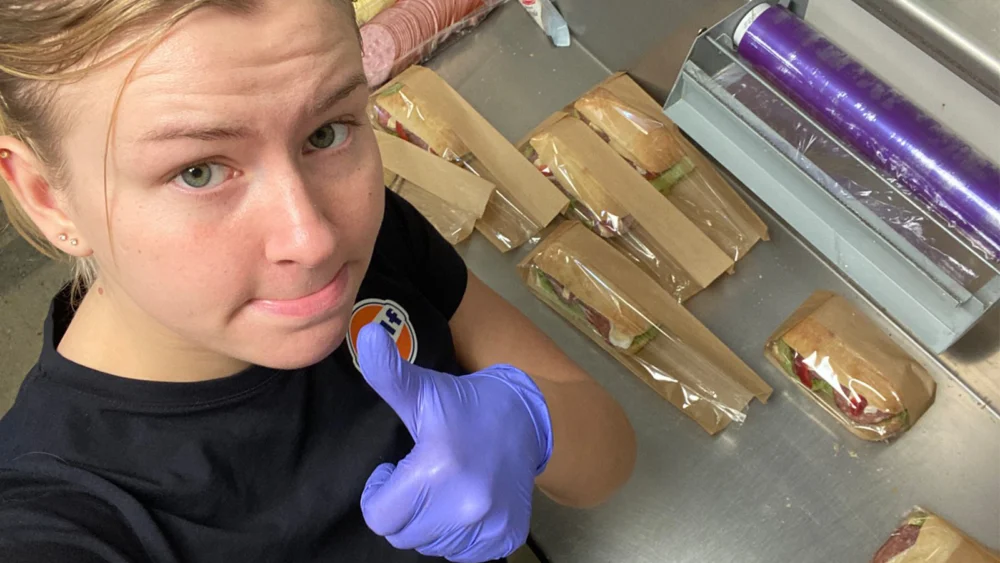
In a move that has resonated deeply within the gaming community and beyond, Swedish Counter-Strike 2 player and commentator Tilde "7liciousCSGO" Byström has become an internet sensation after sharing a candid photograph of herself at her day job, meticulously crafting sandwiches. The image, posted on November 19 to the social media platform X (formerly Twitter), quickly captured widespread attention, sparking conversations about the often-challenging economic landscape faced by professional esports athletes, particularly women in the scene.
Byström’s post, accompanied by the caption, “After 10 years in esports, I’m officially a sandwich maker,” was accompanied by a lighthearted image of herself offering a cheerful thumbs-up to the camera. Behind her, her workstation was laden with neatly prepared sandwiches, each bagged in brown paper, ready for distribution. This seemingly simple photograph served as a poignant and witty commentary on the realities of pursuing a career in professional esports. Despite her decade-long dedication, demonstrable skill in Counter-Strike 2, and experience as both a player and commentator, Byström’s post implicitly highlighted that maintaining financial stability often necessitates a traditional 9-to-5 job, even for those deeply immersed in the high-octane world of competitive gaming.
The viral nature of Byström’s tweet was nothing short of remarkable. Within a span of less than 24 hours, her post garnered over 300,000 likes and accumulated an astonishing 18 million views. The widespread engagement underscores the relatability of her message and the significant public interest in the lives of esports professionals. The post even attracted the attention of major industry players, including the American fast-food chain Pizza Hut, which commented, "Pizza maker is also fire." Byström’s playful reply, "YO! I know how to make a pizza," further amplified the lighthearted, yet meaningful, exchange.
The Deeper Meaning Behind the Viral Post
In an exclusive interview conducted on November 20, Byström elaborated on the multifaceted intentions behind her now-famous sandwich-making photograph. She revealed that the image was a deliberate, dual-purpose statement. Firstly, it served as a "cheeky nod" to the often demeaning and dismissive comments she and other female gamers have encountered from male counterparts within the gaming community. The phrase "Go back to the kitchen and make me a sandwich" is a frequently hurled insult, designed to undermine women’s presence and expertise in gaming. Byström’s photograph directly subverted this trope, reclaiming it with humor and a touch of defiance.
Secondly, and perhaps more critically, the post was a direct reflection of the precarious economic situation facing professional women’s Counter-Strike 2. Byström articulated that the current state of the scene necessitates that she, like many others, holds a conventional job to supplement her income and ensure financial viability. "The post was actually meant as a joke, because as a gamer, I’ve heard, ‘Go back to the kitchen and make me a sandwich,’ like a million times," she explained. "But it is also true that I work by literally making sandwiches from 5 – 10 AM most mornings. It’s a combination of a joke, but at the same time, to be able to survive and pay rent and still play CS2, especially in the current state of the scene for women’s CS, I have to also work a normal job, and pretty much always had to have side jobs while pursuing my dream!"
The Shifting Sands of Women’s Esports Economics
Byström’s candid explanation sheds light on a broader industry trend: the growing instability and shrinking financial support for women’s professional esports leagues and teams. The Counter-Strike 2 scene, in particular, has witnessed significant setbacks in recent years. A prime example is the cessation of operations for ESL Impact, one of the premier women’s Counter-Strike circuits. After its eighth season concluded in October, ESL cited that the "current economic model is simply not sustainable" for its continuation. This decision sent ripples of concern through the community, highlighting the delicate financial footing upon which many esports ventures operate.
Furthermore, several prominent Counter-Strike organizations have recently dissolved their women’s rosters, attributing the decision to similar economic concerns. Natus Vincere (NAVI), a highly recognized esports club, publicly stated that the business model for their women’s CS2 division "seems unsustainable and does not allow for long-term planning." Such pronouncements underscore a pattern of financial challenges that make it difficult for organizations to commit to long-term support for their female rosters, impacting player stability and career progression.
A Decade of Dedication and the Pursuit of a Dream
Byström’s journey in esports spans a decade, a testament to her passion and resilience. During this time, she has been affiliated with several high-profile esports organizations, including Evil Geniuses Gold and Ghost Gaming. Despite these affiliations, the salaries offered have not been sufficient to provide a full-time, sustainable living wage. This reality has forced Byström, and countless other aspiring professionals, to seek alternative employment to support their gaming ambitions.
Her dedication to Counter-Strike began with streaming in 2015, evolving into a focused pursuit of a professional career in 2019. Throughout this period, the dream of competing at the highest level has been intertwined with the necessity of managing financial responsibilities through various side jobs. This dual existence is a common narrative for many individuals striving to break into and sustain themselves within the competitive esports ecosystem.
The Future Vision: Mixed Leagues and Equal Opportunity
Looking ahead, Byström holds a clear and ambitious vision for the future of women’s Counter-Strike. Her ultimate aspiration is to witness the evolution of the esport to a point where mixed-gender leagues become a reality. This would signify a significant stride towards true gender parity within competitive gaming, where skill and performance, rather than gender, are the primary determinants of success and opportunity.
"I’ve been playing full-time in Evil Geniuses. I’ve also been in other organizations and getting a salary, but not any that is covered for full-time," Byström stated. "The dream for me is that women’s CS can evolve so much that we can, in the future, have mixed teams!" This vision encapsulates a desire for a more inclusive and integrated esports landscape, where the talent and dedication of all players are recognized and supported equally.
The viral moment created by Tilde Byström’s humble yet powerful post serves as a crucial reminder of the ongoing challenges and aspirations within professional esports. Her story resonates not only as a personal narrative of perseverance but also as a broader commentary on the economic realities and the persistent quest for equality in the rapidly evolving world of competitive gaming. The widespread engagement her post received indicates a strong public appetite for greater transparency and support for athletes navigating the complexities of the esports industry.