

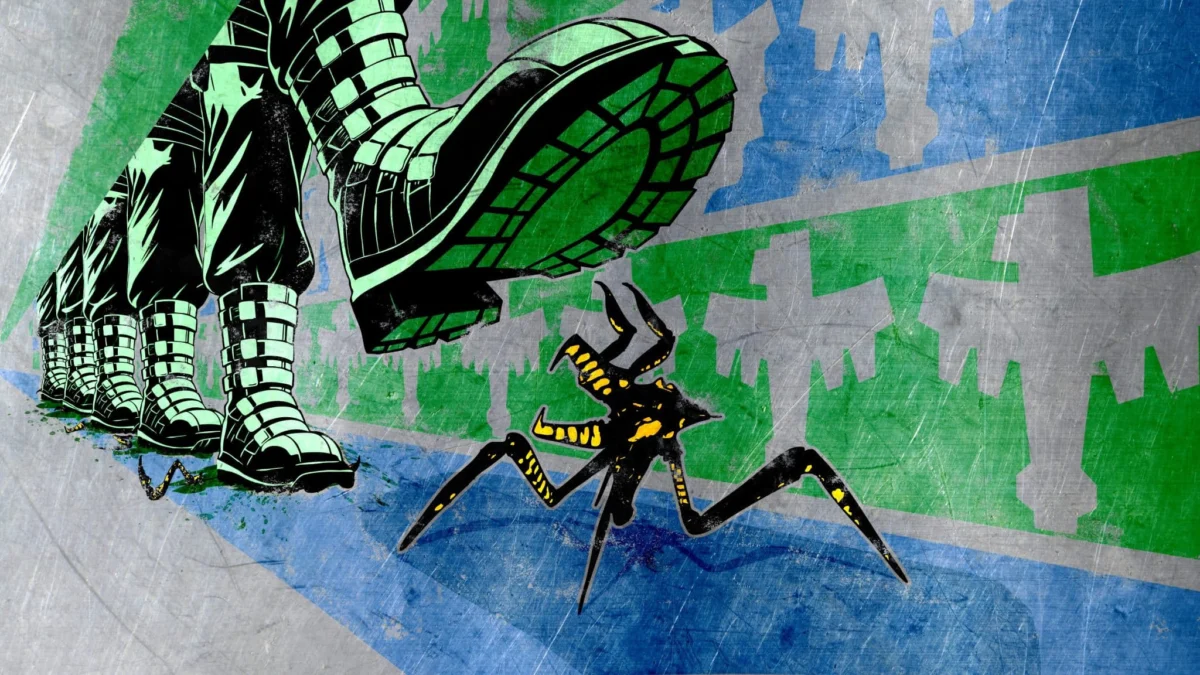
Testing conducted on both the PlayStation 5 and various PC configurations reveals a title that prioritizes high-volume combat and period-accurate aesthetics over modern mechanical complexity. By blending the frantic pace of 2.5D sprite-based shooters with the objective-driven map design popularized by early entries in the Battlefield and Star Wars: Battlefront series, Auroch Digital has carved out a specific niche within the current "boomer shooter" revival.
A Meta-Narrative Approach to Imperial Satire
In a creative departure from standard licensed adaptations, Starship Troopers: Ultimate Bug War! adopts a meta-narrative framework. The game is presented as an official piece of Federation propaganda—a licensed military simulation used to recruit and radicalize the youth of United Earth. This framing allows the developers to lean heavily into the campy jingoism and over-the-top patriotism that defined Paul Verhoeven’s 1997 film adaptation, rather than the more somber tone of Robert A. Heinlein’s original 1959 novel.
The narrative is anchored by Full Motion Video (FMV) sequences featuring returning franchise icon General John “Johnny” Rico, alongside a new character, Major Sammy Dietz. These sequences serve as mission briefings that reinforce the moral obligation of the citizenry to participate in the eradication of the Arachnid species. Industry analysts suggest this approach to storytelling is becoming increasingly popular in retro-inspired games, as it provides a stylistic justification for the simplified mechanics and repetitive loops inherent to the genre.

The inclusion of these FMV scenes serves a dual purpose: they act as a nostalgic bridge for fans of the original cinematic trilogy and provide a satirical layer that critiques the very military-industrial complex the players are participating in. This "veil of irony" has long been a hallmark of the Starship Troopers IP, and its integration here is designed to resonate with players who value the franchise’s unique brand of social commentary.
Hybrid Visuals and Performance Metrics
Technologically, the game employs a distinctive visual style that bridges two specific eras of PC gaming. While the environments are rendered in full 3D, featuring expansive biomes and complex terrain, the majority of moving assets—including the soldiers, the various castes of "Bugs," and even some vehicles—are presented as 2D rotating sprites. This technique, reminiscent of mid-90s titles like Duke Nukem 3D or Doom, allows for a high density of units on screen without the performance overhead typically associated with modern 3D modeling.
Technical assessments performed across multiple platforms indicate a high degree of optimization. On the PlayStation 5, the title maintains a stable frame rate even during "Bug Hole" breaches where dozens of Arachnid units swarm the player simultaneously. PC testing across a spectrum of hardware—from entry-level GPUs to high-end workstations—showed consistent performance, confirming that the game is "lightweight" by modern standards. This accessibility is likely a strategic move by Dotemu to ensure the title runs on portable hardware like the Steam Deck and older console iterations.
The environmental design takes players through a variety of exotic locations, moving beyond the monochromatic desert landscapes often associated with the franchise. These colorful, detailed biomes provide a visual contrast to the gritty, sprite-based violence of the combat, enhancing the "simulation" feel of the meta-narrative.

Mechanical Depth and Tactical Combat
The core gameplay loop of Starship Troopers: Ultimate Bug War! revolves around large-scale warfare maps featuring multiple points of interest. Each mission begins with a landing sequence—which serves as a thematic setup for the ensuing chaos—before tasking the player with a series of non-linear objectives. These tasks typically involve:
- Securing Landing Zones: Clearing initial Arachnid infestations to allow for reinforcements.
- Demolition Operations: Utilizing explosives to neutralize anti-air Bug structures or deep-tunneling nests.
- Resource Management: Managing a limited selection of firearms, grenades, and melee tools while relying on timed aerial supply drops for ammunition and armor.
- Vehicle Integration: Utilizing stationary turrets and pilotable mechs to combat larger Arachnid threats.
The combat is characterized by its "no-room-to-breathe" intensity. Both human and Arachnid forces receive continuous reinforcements, creating a persistent frontline that shifts as objectives are completed. While the weapon variety is described as focused rather than expansive, the addition of tactical options—such as calling in mini-nukes or designating targets for orbital strikes—adds a layer of strategic planning to the otherwise frantic gunplay.
A notable feature is the scoring system, which evaluates player performance based on kill counts and objective efficiency. This system, coupled with various difficulty settings and hidden "cheat codes" reminiscent of 90s gaming culture, is intended to drive replayability in the absence of traditional live-service elements.
The Arachnid Perspective: A Divergent Mode
In an effort to provide a comprehensive look at the "Bug War," Auroch Digital included five specialized missions where players assume the role of an Arachnid "commander." This mode shifts the perspective entirely, allowing players to control a unit capable of morphing between ground-based and flying states.

In these missions, the objective is the destruction of Federation outposts and the slaughter of human infantry. Players can evoke reinforcements, summoning waves of smaller insects to overwhelm fortified positions. While this mode is shorter than the main human campaign—contributing to a total estimated playtime of approximately eight hours—it serves as a mechanical "palate cleanser" and offers a unique view of the franchise’s central conflict.
Contextualizing Auroch Digital’s 2026 Roadmap
The release of Starship Troopers: Ultimate Bug War! is a component of a much larger production cycle for Auroch Digital. The studio is currently managing three major projects slated for 2026:
- Starship Troopers: Ultimate Bug War!: The current retro-FPS release.
- Warhammer 40,000: Boltgun 2: A direct sequel to their breakout 2023 hit.
- Warhammer Survivors: A "bullet heaven" collaboration with poncle (the creators of Vampire Survivors).
This aggressive release schedule suggests that Auroch Digital is positioning itself as a primary steward for high-profile IP adaptations within the retro-gaming market. By specializing in "boomer shooters" and arcade-style experiences, the studio is capitalizing on a growing trend of "AA" development that prioritizes stylized aesthetics and core gameplay loops over the bloated budgets of "AAA" titles.
Market Analysis and Broader Implications
The Starship Troopers IP has seen a resurgence in the gaming sector over the last few years. From the real-time strategy of Starship Troopers: Terran Command to the co-op extraction shooter mechanics of Starship Troopers: Extermination, the franchise is being used to explore various genres.

However, Starship Troopers: Ultimate Bug War! enters the market with a notable limitation: the complete absence of multiplayer or cooperative play. In an era where squad-based shooters are the industry standard for sci-fi military IPs, the decision to remain strictly single-player is a polarizing one. From a journalistic perspective, this suggests that Auroch Digital and Dotemu are targeting a specific demographic of solo players who value "pick-up-and-play" experiences over the social requirements of modern online gaming.
The lack of multiplayer also highlights a potential missed opportunity for large-scale factional warfare, which the game’s map design seems naturally suited for. Industry experts note that while the single-player campaign is a polished "riot" of action, its longevity may be hindered by the lack of community-driven content or competitive modes.
Conclusion
Starship Troopers: Ultimate Bug War! is a faithful, if focused, adaptation of a beloved science fiction property. It successfully captures the visual and mechanical spirit of early 2000s shooters while maintaining the satirical edge that defines the source material. While it may not reach the same heights of mechanical refinement seen in the developer’s previous work on Boltgun, it serves as a robust entry in the growing catalog of retro-revival titles.
As the industry continues to look backward for inspiration, titles like this demonstrate the viability of blending nostalgic presentation with modern hardware stability. For fans of the Federation and those looking to "do their part" in the virtual trenches, the game offers a concentrated dose of Arachnid-slaying action, provided they are content with a purely solitary tour of duty.