

The Razer Blade 18 (2025) has entered the premium hardware market as a definitive statement on the current capabilities of high-end mobile computing, merging the form factor of a laptop with the internal specifications typically reserved for high-end desktop workstations. As the flagship of Razer’s 2025 lineup, this device is engineered to cater to two primary demographics: professional content creators requiring immense multi-threaded performance and enthusiast gamers demanding the highest possible frame rates at 4K resolutions. Over a three-month testing period, the hardware demonstrated a capacity to handle the most taxing modern workloads, though its sheer scale and price point position it as a niche "desktop replacement" rather than a traditional portable computer.

Technical Specifications and Hardware Architecture
The core of the Razer Blade 18’s performance lies in its integration of the NVIDIA GeForce RTX 5090 Laptop GPU. This graphics processor, operating at a 175W Total Graphics Power (TGP), utilizes 24GB of GDDR7 VRAM. The inclusion of GDDR7 represents a significant generational leap in memory bandwidth, facilitating smoother asset streaming in open-world games and faster render times in 3D modeling applications. Supporting this graphical prowess is the Intel Core Ultra 9 275HX (Series 2) processor. This CPU features 24 cores and 24 threads with a maximum boost clock of 5.4GHz, designed to balance high-performance throughput with the efficiency required for a mobile chassis.

To prevent thermal throttling in such a dense environment, Razer implemented a comprehensive Vapor Chamber cooling system. This chamber covers approximately 57% of the motherboard’s surface area, utilizing liquid-to-vapor phase changes to dissipate heat across a larger surface area than traditional heat pipes. The unit tested also featured 64GB of DDR5-5600MHz RAM and a 4TB PCIe Gen4 SSD, ensuring that data bottlenecks are virtually non-existent during high-bitrate video editing or complex simulations.

Design Philosophy and Build Quality
Razer has maintained its signature aesthetic with the 2025 model, utilizing a CNC-milled aluminum chassis that is anodized in a professional matte black finish. Despite its massive 18-inch footprint, the laptop remains remarkably thin, measuring between 0.86 and 1.1 inches in thickness. However, the density of the internal components results in a significant weight of 7.06 lbs (3.2kg). This weight, combined with the physical dimensions, necessitates a large backpack and makes "lap use" practically difficult, reinforcing its status as a stationary desktop replacement.

The design includes several notable RGB elements powered by Razer Chroma. Beyond the standard per-key keyboard backlighting and the illuminated logo on the lid, the 2025 model introduces an RGB "viewing window" on the bottom panel. This window allows users to see the internal Vapor Chamber, a stylistic choice that serves no functional purpose but highlights the engineering complexity of the device. The keyboard itself provides a 1.5mm key travel and a 63g actuation force, including a dedicated (though compact) numpad, which remains a rare and welcomed feature in the gaming laptop space.

The Dual-Mode Display Innovation
One of the most publicized features of the Razer Blade 18 is its 18-inch IPS display, which offers a 16:10 aspect ratio. The panel is unique for its "dual-mode" functionality, allowing users to toggle between two distinct profiles depending on their current task:

- UHD+ Mode: 3840 x 2400 resolution at a 240Hz refresh rate.
- FHD+ Mode: 1920 x 1200 resolution at a 440Hz refresh rate.
In testing, the UHD+ mode provided exceptional clarity for productivity and cinematic gaming. However, the switch to FHD+ for the 440Hz refresh rate presented software challenges. Windows 11 frequently struggled with the scaling adjustments required during the transition, often necessitating manual intervention to correct text size and icon placement. Furthermore, while the 440Hz mode is aimed at professional eSports players, the practical benefits over 240Hz are subject to diminishing returns for the average user. A notable omission for a device in this price bracket is the lack of HDR (High Dynamic Range) support, which limits the display’s peak brightness and color contrast compared to OLED or Mini-LED competitors.

Connectivity and Peripheral Support
The Razer Blade 18 is equipped with an expansive array of ports, designed to eliminate the need for external dongles. On the right side, the device features a Thunderbolt 5 port—a significant upgrade for future-proofing high-speed data transfers—alongside an HDMI 2.1 port, a USB 3.2 Gen 2 Type A port, and a UHS-II SD card reader. The left side houses a 2.5Gbps Ethernet port, two additional USB 3.2 Gen 2 Type A ports, a Thunderbolt 4 port, and a 3.5mm audio combo jack.

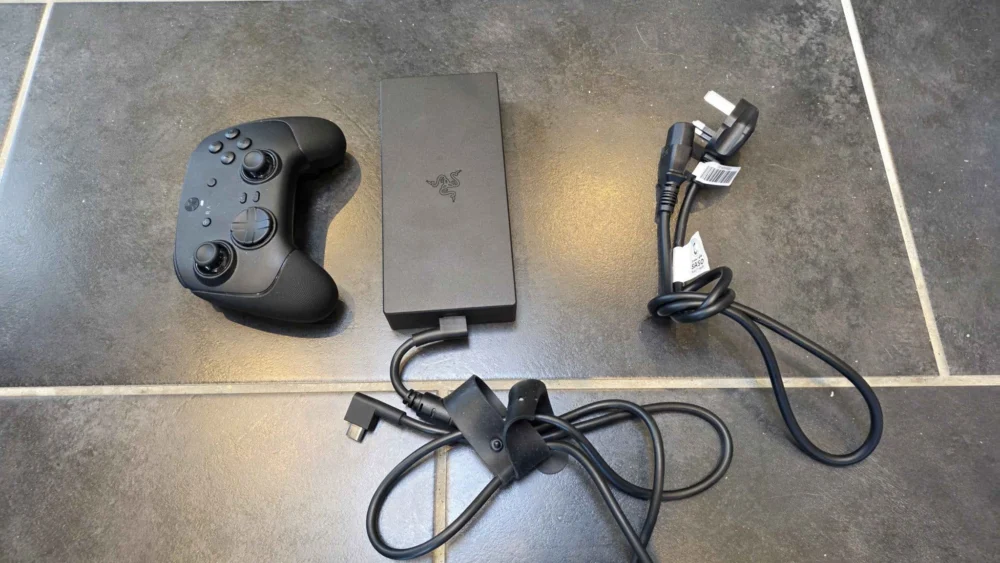
Powering this hardware requires a substantial energy source. The laptop comes with a proprietary 400W GaN (Gallium Nitride) power brick. While GaN technology allows the brick to be smaller than traditional silicon-based chargers of the same wattage, it remains a heavy and bulky addition to a user’s travel kit.

Performance Benchmarks and Real-World Gaming
The integration of the RTX 5090 allows the Razer Blade 18 to utilize NVIDIA’s full suite of AI-driven technologies, including DLSS 3.5 (Deep Learning Super Sampling) and Frame Generation. In benchmarking Cyberpunk 2077 at 4K resolution with various high-end settings enabled, the system maintained an average of 90 FPS. The visual fidelity provided by the combination of path tracing and AI upscaling resulted in a flagship-tier gaming experience.

Other tested titles included:

- High on Life 2: Ran at maximum settings with no perceptible stuttering, fully utilizing the RTX 5000 series’ architectural improvements.
- REANIMAL: Utilizing Unreal Engine 5’s Nanite lighting technology, the game averaged 136 FPS, demonstrating the laptop’s ability to handle high-geometry environments.
- Sektori: A less demanding title that allowed the display to reach its 240Hz cap in UHD mode, providing a locked and fluid visual experience.
While performance was exemplary, the cooling fans reached audible levels during sustained gaming sessions. While the noise was not described as "jarring," it is a necessary byproduct of keeping the high-TGP components within safe operating temperatures.

Software Integration and the Console Experience Experiment
During the review period, attempts were made to utilize Microsoft’s "Xbox Full Screen Experience" to transform the Razer Blade 18 into a console-like gaming hub. This experiment highlighted current limitations in the Windows ecosystem for high-end laptops. Issues included the system’s inability to reliably wake from sleep via a wireless controller and inconsistencies in how the OS handled background tasks while in the "console" interface. This suggests that while the hardware is more than capable of providing a console-beating experience, the software layer for "living room" PC gaming still requires significant refinement from Microsoft and hardware manufacturers.

Broader Impact and Market Implications
The Razer Blade 18 (2025) sits at the top of a pricing structure that begins at $3,499 and reaches $5,199.99 for the fully specced RTX 5090 configuration. This pricing places it well beyond the reach of the average consumer and even many professional gamers. However, the existence of such a device serves as a "halo product" for the industry, pushing the boundaries of what is possible within a mobile thermal envelope.

The broader implication of this device is the continued blurring of the line between mobile and desktop computing. For professionals who move between studios or events—such as video editors or eSports tournament organizers—the ability to carry a machine that rivals a mid-to-high-tier desktop tower is a significant logistical advantage. Nevertheless, the trade-off remains the battery life. Despite the 99 Whr battery (the maximum allowed by the FAA for air travel), the laptop provides only approximately two hours of use for basic productivity and significantly less for gaming. This reinforces the conclusion that the Razer Blade 18 is not intended for use in transit, but rather as a portable workstation that requires a power outlet for its full potential to be realized.

Conclusion
The Razer Blade 18 (2025) is a masterpiece of industrial design and hardware engineering, successfully housing the most powerful mobile components currently available. While the lack of HDR and the software friction of the dual-mode display are valid criticisms at a $5,000 price point, they do little to diminish the raw performance capabilities of the machine. It stands as a specialized tool for those who require the absolute maximum in mobile performance and are willing to navigate the compromises of weight, battery life, and cost. For the enthusiast market, it represents the current ceiling of the gaming laptop category.