

The Razer Blade 18 (2025) has emerged as a flagship entry in the premium gaming laptop market, positioning itself as a definitive desktop replacement for enthusiasts and creative professionals. Built around the latest hardware from Intel and NVIDIA, this machine represents the apex of Razer’s engineering, offering a blend of high-fidelity aesthetics and raw computational power. With a retail price scaling up to $5,199.99 for the top-tier configuration, the device aims to justify its significant investment through cutting-edge features, including a dual-mode display and the debut of the NVIDIA GeForce RTX 5090 laptop GPU.

Hardware Architecture and Internal Specifications
The Razer Blade 18 is powered by the Intel Core Ultra 9 275HX (Series 2) processor. This CPU architecture is designed for high-performance workloads, featuring a maximum boost speed of 5.4GHz and a configuration of 24 cores and 24 threads. This processing power is paired with 64GB of DDR5-5600 MHz RAM, ensuring that the system can handle intensive multi-tasking, high-resolution video editing, and complex 3D rendering without bottlenecks.
The centerpiece of the internal hardware is the NVIDIA GeForce RTX 5090 Laptop GPU. Operating at a 175W Total Graphics Power (TGP), the GPU is equipped with 24GB of GDDR7 VRAM, a significant leap over previous generations. This hardware enables the use of advanced NVIDIA technologies, including third-generation Ray Tracing cores and fourth-generation Tensor cores, facilitating features such as DLSS 3.5 Frame Generation and sophisticated AI-driven upscaling.

Storage is equally robust, featuring a 4TB PCIe Gen 4 SSD. This provides not only ample space for modern AAA game titles—which frequently exceed 100GB in size—but also the high-speed data transfer rates required for 4K video scrubbing and rapid system boot times.
Thermal Management and Industrial Design
To manage the heat generated by such high-performance components, Razer has implemented an expansive thermal solution. The Blade 18 utilizes a custom-engineered Vapor Chamber that covers approximately 57% of the motherboard’s surface area. This system is designed to dissipate heat more efficiently than traditional heat pipe designs, allowing the CPU and GPU to maintain higher clock speeds for longer durations without thermal throttling.

The chassis is CNC-milled from a single block of anodized black aluminum, maintaining Razer’s signature sleek, professional aesthetic. Despite its large 18-inch footprint, the laptop remains remarkably thin, measuring between 0.86 and 1.1 inches in thickness. However, the density of the internal components results in a significant weight of 7.06 lbs (3.2 kg).
A unique design element introduced in this model is the RGB "viewing window" on the bottom of the chassis. This transparent section allows users to see the internal Vapor Chamber, illuminated by Razer’s Chroma RGB lighting. While primarily an aesthetic addition, it highlights the engineering focus on thermal performance that defines the 2025 model.

Display Innovation: The Dual-Mode Panel
Razer has equipped the Blade 18 with a specialized 18-inch IPS display that offers a 16:10 aspect ratio. The defining feature of this panel is its dual-mode functionality, allowing users to switch between two distinct performance profiles depending on their current task:
- UHD+ Mode: This mode offers a resolution of 3840 x 2400 at a 240Hz refresh rate. It is intended for creative professionals who require high pixel density for photo and video editing, as well as gamers who prioritize visual fidelity.
- FHD+ Mode: This mode drops the resolution to 1920 x 1200 but increases the refresh rate to 440Hz. This is aimed specifically at competitive eSports players where frame-to-frame latency is more critical than image resolution.
While the display is highly versatile, it is notable for its lack of HDR (High Dynamic Range) support. In a price bracket exceeding $5,000, the absence of HDR or a Mini-LED option may be viewed as a missed opportunity, especially given the visual capabilities of the RTX 5090.

Connectivity and Peripheral Integration
The Blade 18 is designed to serve as a hub for a full workstation or gaming setup. Its port selection is among the most comprehensive in the laptop market:
- Right Side: Thunderbolt 5 port, HDMI 2.1 output, one USB 3.2 Gen 2 Type-A port, and a UHS-II SD card reader.
- Left Side: 2.5Gbps Ethernet port, two USB 3.2 Gen 2 Type-A ports, a Thunderbolt 4 port, a 3.5mm combo audio jack, and the proprietary power input.
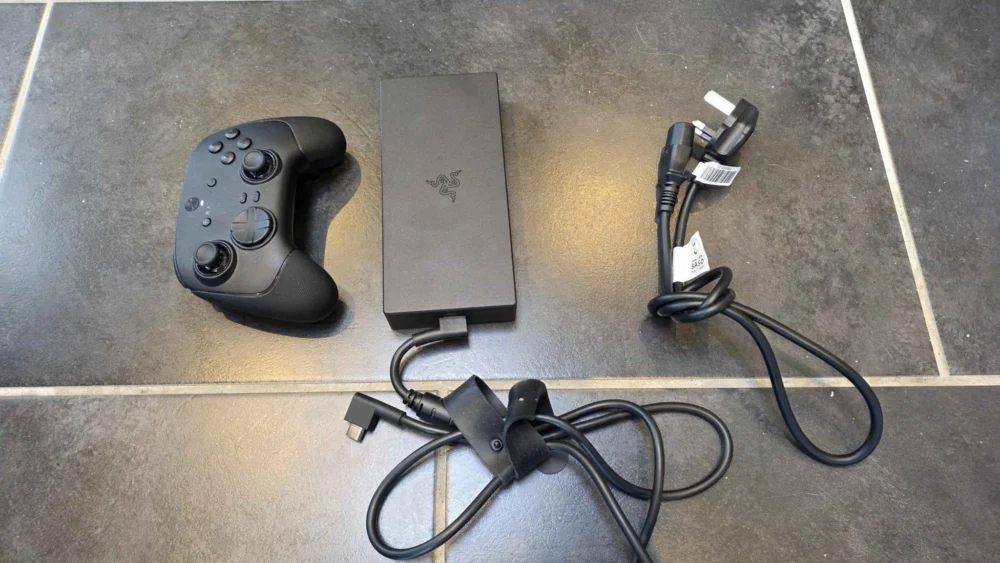
The inclusion of Thunderbolt 5 is a significant forward-looking feature, offering up to 120Gbps of bandwidth for external displays and high-speed storage arrays. The laptop also features a 99.9 Whr battery—the maximum capacity allowed for air travel by the FAA—and a massive 400W GaN power brick to support the hardware’s power draw.

The user interface includes a per-key RGB backlit keyboard with 1.5mm of travel and 63g of actuation force. Notably, Razer has included a compact numeric keypad, a feature often omitted in gaming laptops. The trackpad is exceptionally large, occupying a significant portion of the lower deck, and is complemented by a six-speaker array tuned with spatial audio capabilities via Razer Synapse.
Performance Benchmarks and Gaming Analysis
In real-world testing, the Razer Blade 18 (2025) demonstrates performance that rivals high-end desktop configurations. Utilizing the RTX 5090’s capabilities, the machine handles modern titles at 4K resolutions with high frame rates.

- Cyberpunk 2077: Using the UHD+ resolution and a mix of high settings with Ray Tracing enabled, the system averaged 90 FPS. The use of NVIDIA’s Frame Generation technology was instrumental in maintaining this performance at 4K.
- REANIMAL: Utilizing Unreal Engine 5’s Nanite and Lumen technologies, the Blade 18 achieved a consistent 136 FPS, showcasing its ability to handle next-generation lighting and geometry.
- Sektori: In less demanding titles, the laptop fully utilized its 240Hz UHD+ display mode, maintaining a locked 240 FPS.
While the hardware is capable of extreme performance, the software experience remains a point of contention for some users. Attempts to use Microsoft’s "Xbox Full Screen Experience" to turn the laptop into a console-like device met with technical hurdles, including issues with controller-based wake functions and OS scaling when switching between display modes.
The Portability Paradox and Market Implications
The Razer Blade 18 sits in a category often referred to as "lugglable" rather than portable. While it can be transported in a backpack, the combined weight of the laptop and the 400W power brick makes it a heavy burden for daily commuting. Furthermore, battery life remains a significant limitation of the desktop-replacement class; under standard productivity loads or web browsing, the device lasts approximately two hours, with that figure dropping significantly during gaming sessions.

The market for this device is specialized. It targets:
- High-End Enthusiasts: Those who want the absolute best mobile hardware regardless of cost.
- Traveling Professionals: Video editors, 3D animators, and developers who require a workstation-grade PC that can be moved between studios or event locations.
- Desktop Minimalists: Users who want desktop power without the footprint of a full tower and monitor setup.
Broader Impact on the PC Industry
The release of the Razer Blade 18 (2025) underscores several trends in the PC industry. First, the move toward 18-inch displays suggests that manufacturers are successfully finding a market for larger, more immersive mobile screens. Second, the integration of 24GB VRAM in a laptop GPU marks a milestone for mobile content creation, allowing for the local processing of large AI models and high-resolution textures that previously required server-grade hardware or multiple desktop GPUs.

However, the rising cost of these flagship devices—now crossing the $5,000 threshold—creates a widening gap between mainstream gaming laptops and the "ultra-premium" tier. This pricing reflects the increased costs of specialized components like CNC-milled aluminum, vapor chambers, and high-refresh-rate dual-mode panels.
Conclusion
The Razer Blade 18 (2025) is an uncompromising piece of technology that fulfills its promise as a desktop replacement. It offers industry-leading specs, a sophisticated design, and a display that caters to both the ultra-competitive gamer and the detail-oriented creator. While its price, weight, and battery life prevent it from being a practical choice for the average consumer, it stands as a benchmark for what is currently possible in the realm of mobile computing. For those who require peak performance in a mobile-adjacent form factor, the Blade 18 represents the current state of the art, provided they are willing to navigate the logistical challenges of its size and the financial demands of its price tag.