

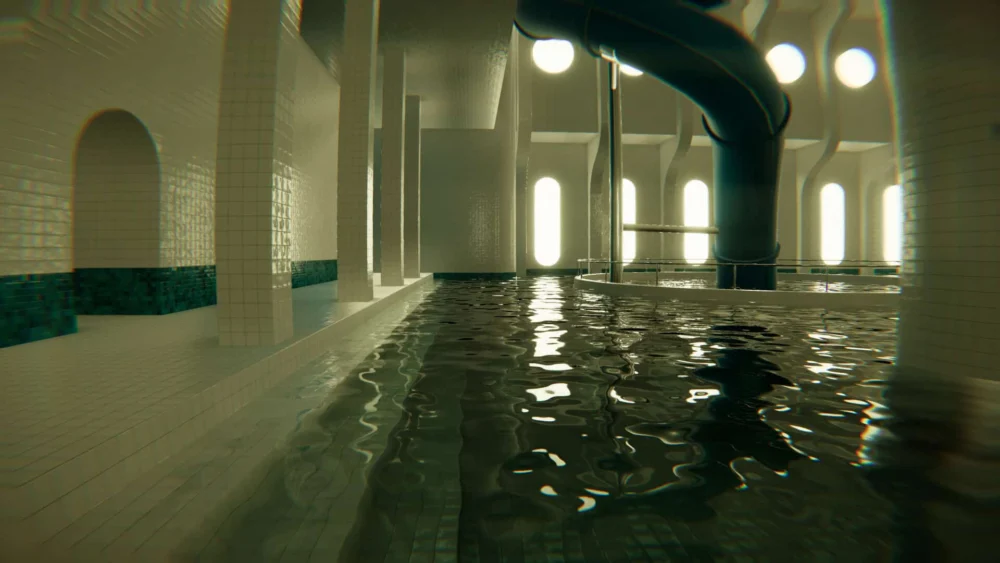
The release of POOLS on the Nintendo Switch 2 marks a significant milestone for the 2024 walking simulator, bringing its distinctive exploration of liminal spaces to a handheld platform capable of maintaining its high-fidelity aesthetic. Developed by Tensori, the title originally garnered critical acclaim on PC and PlayStation 5 for its minimalist approach to the "Backrooms" internet phenomenon. Unlike traditional horror entries that rely on overt antagonists or complex mechanical systems, POOLS focuses exclusively on environmental storytelling and psychological atmosphere. The transition to Nintendo’s successor hardware provides an opportunity to evaluate how the console’s upgraded architecture handles the game’s demanding lighting and reflective surfaces, which are central to its immersive qualities.
The Evolution of the Liminal Space Genre
The "Backrooms" aesthetic, characterized by endless, repetitive, and often eerie architectural spaces, transitioned from an internet creepypasta to a legitimate sub-genre of indie gaming over the early 2020s. POOLS represents the apex of this trend, specifically focusing on the "Poolrooms" variant of the lore. This aesthetic relies on high-contrast tiling, sanitized white walls, and the unsettling juxtaposition of recreational architecture with total isolation.

Historically, the genre began with simple recreations of yellow-carpeted office mazes. However, as developers gained access to more sophisticated tools like Unreal Engine 5, the focus shifted toward hyper-realism. POOLS was a pioneer in this regard when it launched in 2024, utilizing advanced water shaders and global illumination to create spaces that felt tangible yet fundamentally wrong. The game’s arrival on the Switch 2 in early 2026 signifies the hardware’s ability to bridge the gap between high-end PC visuals and portable gaming, a feat previously difficult for the original Switch hardware due to the complexity of real-time reflections on tiled surfaces.
Chronology of Development and Release
The development timeline of POOLS is closely intertwined with the broader "Dreamcore" movement in independent gaming. In late 2023, a playable demo for a project titled Dreamcore—specifically its Dreampools level—captured significant attention for its use of a bodycam-style perspective. Industry analysts suggest that this demo served as a catalyst for a wave of similar projects, including POOLS.
By early 2024, Tensori released POOLS on PC and PlayStation 5. The game was structured into six primary chapters, each escalating in surrealism. While Dreamcore eventually saw a full release in 2025, expanding into various other liminal environments like suburban streets and malls, POOLS remained dedicated to its aquatic theme. The decision to port the title to the Nintendo Switch 2 follows a period of optimization where the developers sought to maintain the "found footage" visual style while adapting to the mobile chipset’s unique power profile.

Technical Specifications and Switch 2 Performance
The Nintendo Switch 2 version of POOLS utilizes several key technologies to achieve its hyper-realistic look. Most notable is the implementation of NVIDIA’s Deep Learning Super Sampling (DLSS). Given the game’s reliance on sterile, reflective environments, the hardware must process a high volume of light bounces off white tiles and water.
Technical benchmarks indicate a divergence in performance between the console’s two primary modes:
Docked Mode Performance
In docked mode, the Switch 2 targets a higher internal resolution, allowing the sterile environments of POOLS to appear crisp and stable. The increased power draw allows for more sophisticated anti-aliasing, which is crucial for a game that features numerous straight lines and geometric patterns. The "VHS filter" and chromatic aberration effects, which are used to simulate a bodycam recording, blend seamlessly with the high-resolution output, providing a convincing "found footage" experience.

Handheld Mode and DLSS Implementation
In portable mode, the game operates at a lower base resolution, relying heavily on DLSS to upscale the image to the device’s screen. While this maintains a fluid frame rate, some visual trade-offs have been identified. Specifically, on highly reflective surfaces—such as the still water in Chapter 1 or the tiled saunas in Chapter 3—noticeable white pixel artifacts and minor aliasing can occur. These artifacts are common side effects of aggressive upscaling in environments with high-frequency detail. However, the overall atmospheric integrity remains intact, making it one of the most visually impressive titles currently available in a handheld format.
Core Gameplay Mechanics and Philosophy
POOLS is frequently categorized as a "walking simulator," a term that has evolved from a pejorative to a specific descriptor for narrative-heavy, mechanic-light experiences. The game intentionally strips away traditional gaming elements to heighten the player’s sense of presence.
- Absence of HUD: There are no health bars, maps, or objective markers. The player’s screen is entirely dedicated to the environment, mimicking the view through a camera lens.
- Lack of Interaction: The player cannot pick up items, engage in combat, or solve traditional puzzles. The "challenge" lies in navigation and the psychological endurance of being lost.
- Auditory Focus: The sound design is diegetic, focusing on the echo of footsteps, the hum of fluorescent lights, and the splashing of water. There is no musical score, which amplifies the "uncanny" feeling of the silent corridors.
- Movement Dynamics: While the default walking speed is slow to encourage observation, the game includes a run function and adjustable speed settings in the options menu. This was a response to early feedback regarding the pacing of the larger, maze-like levels.
Analysis of Environmental Progression
The game’s six chapters function as a descent from the mundane to the nightmarish. Chapter 1 begins in what appears to be a standard, albeit oversized, indoor swimming facility. The architecture follows a logical, if repetitive, pattern.

As the player progresses into the middle chapters, the geometry begins to defy physical laws. Water slides extend for miles, and staircases lead to nowhere. By the final chapters, the environment introduces "disturbances"—humanoid statues that appear to move when not observed, and suburban architecture submerged in dark water. This transition mirrors the "Dream-to-Nightmare" cycle often discussed in psychological studies of liminality. The game’s ability to evoke anxiety without relying on "jump scares" is a testament to its environmental design.
Market Reception and Broader Implications
The release of POOLS on a Nintendo platform suggests a widening audience for avant-garde indie titles. Traditionally, Nintendo’s ecosystem has been associated with mechanically dense, family-friendly content. The inclusion of a niche, atmospheric walking simulator like POOLS reflects a shift in the company’s third-party strategy, embracing the "vibes-based" gaming trend that has dominated PC platforms.
Industry experts note that POOLS and its contemporary, Dreamcore, have established a new standard for "passive horror." This genre appeals to a demographic that values atmosphere and aesthetic over traditional gameplay loops. The success of these titles has also influenced the "found footage" film industry, with several independent filmmakers citing the visual language of these games as inspiration for modern horror cinema.

Comparative Study: POOLS vs. Dreamcore
While frequently compared, POOLS and Dreamcore offer distinct experiences within the same aesthetic framework. Dreamcore is an anthology of various liminal spaces, offering a broader look at the genre’s tropes. POOLS, by contrast, is a focused study of a single theme.
The primary difference lies in the pacing and intent. Dreamcore often features more direct nods to the "Backrooms" lore, including entities and more traditional horror elements. POOLS remains more grounded in the psychological "uncanny valley" of architecture. For players on the Switch 2, POOLS serves as a more streamlined, cohesive experience that can be completed in approximately two hours, making it an ideal "one-sitting" experience for portable play.
Conclusion and Future of the Franchise
As of early 2026, Tensori has not officially announced a sequel to POOLS, but the game’s expansion to new platforms indicates continued interest in the IP. The Switch 2 port demonstrates that the industry’s push toward hyper-realism is no longer confined to high-end desktops.

The game’s legacy lies in its minimalism. By removing the "game" from the experience, POOLS forces the player to confront the environment directly. Whether viewed as a technical showcase for the Switch 2’s upscaling capabilities or as a digital art installation, POOLS remains a definitive example of how atmosphere can supersede mechanics in modern interactive media. The port successfully maintains the haunting, sterile beauty of the original release, proving that liminality is a powerful tool for immersion, regardless of the screen size.