
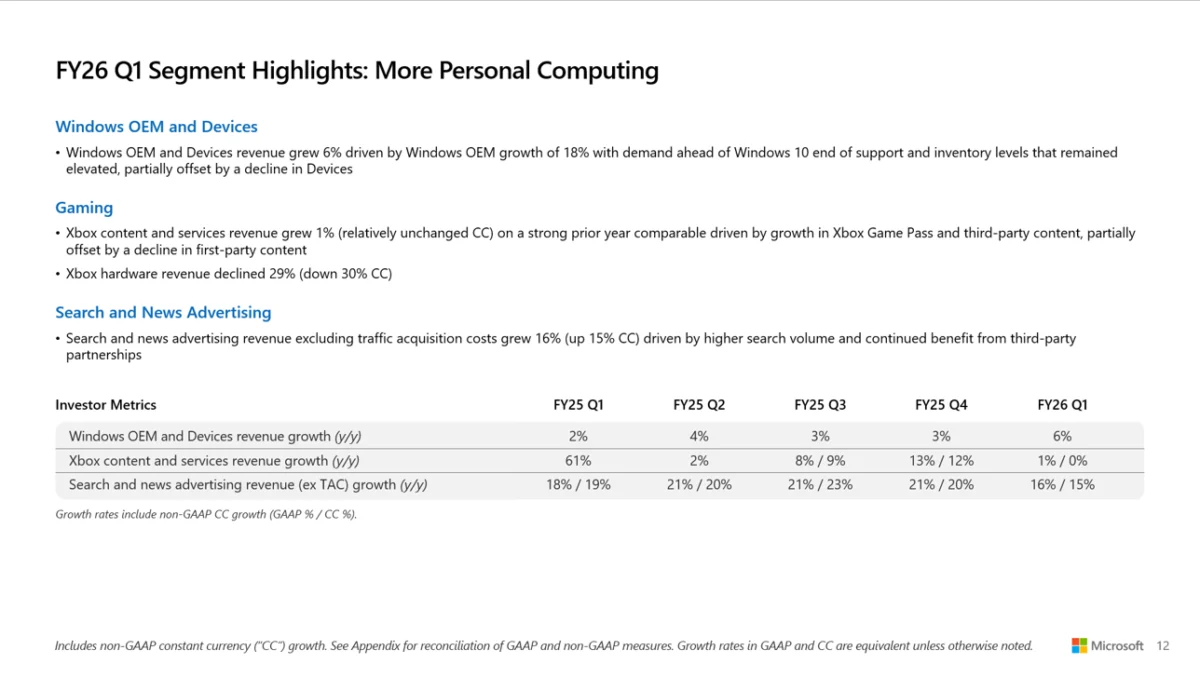
Microsoft appears unfazed by the recent wave of criticism surrounding its decision to increase Game Pass subscription prices. Company executives, during their latest earnings call for the first quarter of fiscal year 2026, indicated an expectation of increased subscriber numbers and a reduction in losses within Xbox’s services division in the upcoming quarter. This optimism stands in contrast to considerable player discontent, which emerged following the announcement of price adjustments that took effect in most regions in October and are slated for broader implementation in November. The financial impact of these hikes will become fully apparent in Microsoft’s next earnings report, anticipated in late January 2026.
Financial Performance and Forward-Looking Statements
The Q1 FY26 earnings call, covering the period from July to September, revealed that Xbox’s content and services revenue, a segment encompassing the popular Game Pass subscription service, remains stable and is even experiencing growth. This performance predates the full effect of the price increases. During the call, a key executive shared insights into the company’s projections for the Xbox division. "And in Xbox content and services, we expect revenue to decline in the low to mid-single digits against a prior year comparable that benefited from strong first-party performance, partially offset by growth in subscriptions," stated the executive.
This particular statement has drawn attention for its nuanced language. While acknowledging an expected overall decline in revenue for the Xbox content and services segment, attributed to strong first-party game releases in the preceding year, the executive simultaneously highlighted an anticipated "growth in subscriptions." This suggests a strategic divergence: either a projection of an absolute increase in the total number of Game Pass subscribers, or a scenario where revenue per subscriber increases due to the price hike, even if the total subscriber count experiences a smaller decline than initially feared. The phrasing strongly implies that Microsoft is banking on the appeal of its gaming portfolio to either retain existing subscribers or attract new ones, thereby bolstering the subscription base despite the higher cost of entry.
The Strategic Importance of Game Pass
Microsoft’s unwavering confidence in Game Pass’s future can be largely attributed to its ongoing investment in exclusive, day-one releases. The platform has become a cornerstone of the Xbox ecosystem, offering a compelling value proposition by providing access to a vast library of games, including AAA titles and independent productions, at a fixed monthly fee. Notable upcoming titles slated for immediate inclusion on Game Pass, such as "Outer Worlds 2" and the next installment in the "Call of Duty: Black Ops" series, underscore Microsoft’s commitment to populating the service with high-profile content. This strategy aims to create a powerful incentive for gamers to subscribe and remain subscribed, thereby offsetting the potential negative impact of price increases on subscriber acquisition and retention.
The rationale behind this strategy appears to be a belief that the sheer volume and quality of games available on Game Pass will ultimately justify the increased subscription costs for consumers. Microsoft’s substantial investment in securing and developing exclusive content for the service is a clear indicator of its long-term vision for Game Pass as a primary driver of engagement and revenue within the gaming division.
Player Reception and Market Dynamics
The announcement of the Game Pass price hikes in October 2025 was met with significant backlash from a segment of the gaming community. Many players expressed concerns that the increased cost would undermine Game Pass’s core appeal as an affordable gateway to a wide range of gaming experiences. Prior to the price adjustments, Game Pass was often lauded for offering a subscription fee lower than the cost of a single new game, providing access to both indie titles and major releases. The new pricing structure, particularly for premium tiers, has led some consumers to question whether the value proposition remains as strong, with some suggesting that it might be more financially prudent to purchase individual games outright.
The criticism highlights a fundamental tension in subscription-based gaming models: balancing profitability with consumer accessibility. While price increases can boost revenue, they also risk alienating a user base that has come to rely on the service’s affordability. The community’s reaction underscores the delicate equilibrium Microsoft must strike to maintain subscriber loyalty and market share in an increasingly competitive gaming landscape.
Historical Context and Industry Trends
The evolution of Game Pass is intrinsically linked to broader shifts in the video game industry. Launched in 2017, Xbox Game Pass initially offered a novel approach to game access, providing a curated library of titles for a monthly fee. Over the years, its value proposition has been significantly enhanced by Microsoft’s acquisition of major game development studios, including Bethesda and Activision Blizzard, and its commitment to releasing first-party titles on day one. This strategy has positioned Game Pass as a significant competitor to traditional game purchasing models and has been widely emulated by other platforms.
The subscription model has become a dominant force in digital entertainment, with services like Netflix, Spotify, and Disney+ setting consumer expectations for access to content libraries. In the gaming sector, competitors such as Sony’s PlayStation Plus have also adapted their offerings to include tiered subscription plans with varying levels of access to game catalogs. Microsoft’s decision to increase Game Pass prices can be viewed within this context of a maturing subscription market, where companies seek to optimize revenue streams from their established subscriber bases.
Data and Financial Projections
While specific subscriber numbers were not detailed in the earnings call, the mention of "growth in subscriptions" alongside an expected revenue decline in the services division suggests a complex financial interplay. If the price hike leads to a significant increase in revenue per subscriber, this could offset a potential dip in the absolute number of users. For instance, if a tier increased from $10 to $15 per month, a 10% decrease in subscribers (from 100 to 90) would still result in higher overall revenue ($1350 vs. $1000). This scenario, where revenue growth outpaces subscriber attrition, would be considered a success from an investor’s perspective.
The first quarter of fiscal year 2026 (July-September 2025) saw Xbox content and services revenue of $3.73 billion, a slight decrease of 1% year-over-year. However, this figure was impacted by a strong prior-year comparable due to significant first-party title releases. The company has consistently emphasized the strategic importance of Game Pass, which has played a pivotal role in the growth of its services division over the past several years. Investors will be closely watching the Q2 FY26 report to gauge the actual impact of the price adjustments on subscriber numbers and overall revenue.
Broader Implications for the Gaming Ecosystem
Microsoft’s continued investment in Game Pass, even with the price increases, signals a long-term commitment to the subscription model as a core pillar of its gaming strategy. This approach has several implications for the broader gaming ecosystem:
- Content Investment: The sustained success of Game Pass incentivizes Microsoft to continue investing heavily in exclusive game development and acquisitions. This can lead to a richer and more diverse gaming library for subscribers, but it also raises questions about the financial viability of third-party games that may not be included in day-one releases.
- Player Expectations: As subscription services become more prevalent, consumer expectations regarding value and access are continually shaped. The Game Pass price hike could set a precedent for other subscription services to re-evaluate their pricing strategies, potentially leading to increased costs for consumers across the board.
- Market Competition: The robust performance of Game Pass pressures competitors to adapt and innovate. Sony, for instance, has revamped its PlayStation Plus service to offer multiple tiers, including access to a catalog of classic and modern games, in an effort to compete more directly with Xbox’s offerings.
- Ownership vs. Access: The shift towards subscription services also sparks ongoing debate about the concept of game ownership. While subscriptions offer convenience and breadth of access, they do not confer permanent ownership of the games played. This raises long-term questions about digital preservation and player autonomy.
Microsoft’s apparent confidence in the face of community concerns suggests a calculated strategic bet. The company appears to believe that the enduring appeal of its gaming content, coupled with the inherent value proposition of Game Pass, will ultimately outweigh the negative sentiment surrounding price increases. The upcoming financial reports will serve as a crucial indicator of whether this strategy proves successful in the competitive landscape of modern gaming.