
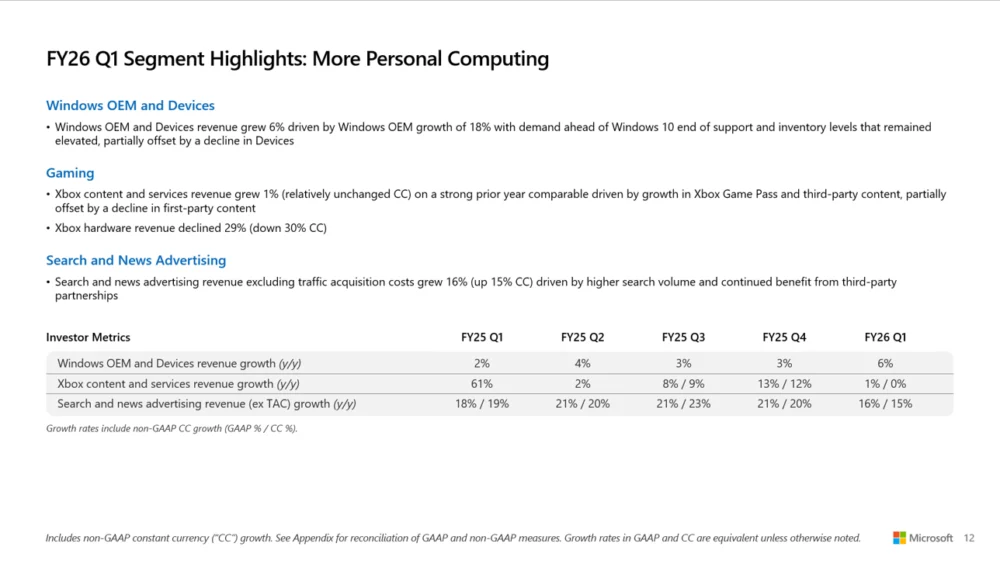
Microsoft executives have signaled a confident outlook for Xbox’s services division, projecting an increase in Game Pass subscriptions and a reduction in losses for the next fiscal quarter, despite significant public criticism following recent price adjustments. This optimistic stance was revealed during the company’s first-quarter earnings call for fiscal year 2026, covering the period from July to September. While the financial results presented do not yet reflect the impact of the Game Pass price hikes, which were implemented in most global markets in October and are set to roll out universally in November, the company’s forward-looking statements indicate a strategic belief in the enduring appeal of its subscription service.
Financial Performance and Future Projections
The Q1 FY26 earnings call, a crucial platform for Microsoft to communicate its financial health and strategic direction to investors, highlighted the resilience of Xbox’s content and services revenue. This segment, which encompasses the popular Game Pass subscription service, was reported as stable and even exhibiting growth during the aforementioned July-September period. This performance predates the price increases, suggesting a robust underlying user base and engagement with the Xbox ecosystem.
Crucially, the company’s projections for the upcoming quarter, which will incorporate the revenue generated from the increased subscription fees, paint a picture of anticipated improvement. A key executive statement during the earnings call provided insight into this forward-looking perspective: "And in Xbox content and services, we expect revenue to decline in the low to mid-single digits against a prior year comparable that benefited from strong first-party performance, partially offset by growth in subscriptions." This phrasing is particularly noteworthy, as it suggests a dual expectation: a potential overall dip in revenue due to comparison with a strong previous year marked by significant first-party releases, yet simultaneously, an anticipated rise in the number of Game Pass subscribers.
This nuanced outlook raises questions about the definition of "growth in subscriptions." It could signify an increase in the absolute number of subscribers, or it could imply a scenario where the revenue generated per subscriber increases due to the price hike, even if the total subscriber count remains stagnant or sees a marginal decline. If the revenue per subscriber effectively compensates for any subscriber attrition, the net financial outcome for the services division could still be viewed positively by the company. Nevertheless, the explicit mention of "growth in subscriptions" strongly implies Microsoft’s strategic bet on attracting and retaining a larger subscriber base, even at a higher price point.
The Game Pass Pricing Conundrum: A Timeline of Events
The decision to increase Game Pass prices was met with considerable backlash from the gaming community. The price adjustments, which began rolling out in October 2025, marked a significant shift in the perceived value proposition of the service. For many years, Game Pass has been lauded for its affordability, offering access to a vast library of games, including high-profile new releases on day one, for a price often comparable to a single new retail game. This accessibility was a cornerstone of its appeal, making gaming more attainable for a wider audience.
The price hikes, however, challenged this established value. In many regions, the cost of Game Pass Ultimate, the premium tier, saw a substantial increase, moving closer to, and in some cases exceeding, the cost of purchasing several individual games. This shift prompted widespread discussion and criticism, with many players expressing concerns that the service was becoming less accessible and potentially undermining the economic model for game developers and publishers in the long run. The sentiment was amplified by the fact that while the library of games offered on Game Pass continued to expand, the core appeal of affordability seemed to be diminishing.
The timing of the earnings call, occurring just before the full financial impact of these price changes would be reflected, allowed Microsoft to present its current performance and its optimistic projections for the future, effectively framing the narrative ahead of the market’s full assessment. The upcoming earnings call in late January 2026 will be the first opportunity to analyze the tangible financial outcomes of the price adjustments and gauge the accuracy of Microsoft’s predictions.
Strategic Underpinnings: The Power of Day-One Releases and Content Investment
Microsoft’s confidence in Game Pass’s future, even in the face of price increases, is deeply rooted in its aggressive content acquisition and development strategy. The company has consistently emphasized its commitment to bringing a steady stream of high-quality, first-party titles to Game Pass on their release day. This includes highly anticipated franchises and new intellectual properties, such as the recently confirmed "Outer Worlds 2" and the forthcoming "Call of Duty: Black Ops 7" (assuming this is the next installment in the Black Ops series).
This strategy aims to leverage the perceived value of immediate access to major releases as a primary driver for subscription. By investing heavily in a robust pipeline of new games, Xbox seeks to create an ecosystem where subscribers feel compelled to remain engaged to avoid missing out on significant titles. The argument is that the cumulative value of these day-one releases, alongside the extensive back catalog, justifies the elevated subscription cost for dedicated gamers. This approach positions Game Pass not merely as a budget-friendly option, but as an indispensable service for enthusiasts who want to play the latest and greatest titles without incurring individual purchase costs for each.
Broader Market Implications and Investor Confidence
The industry is closely watching Microsoft’s strategy with Game Pass. For years, the subscription model has been touted as the future of gaming, promising recurring revenue streams and increased player engagement. However, the recent price adjustments raise questions about the sustainability of this model, particularly regarding consumer price sensitivity and the potential for market saturation.
Microsoft’s unwavering projection of subscription growth in the face of consumer concern could be interpreted in several ways. On one hand, it may reflect a genuine belief in the strength of their content library and the perceived value proposition of Game Pass, even at a higher price. This confidence might stem from internal data suggesting that the core Game Pass audience is less price-sensitive than the broader market, or that the allure of day-one releases is a powerful retention tool.
On the other hand, this confident outlook could also be a strategic maneuver to reassure investors and analysts. In the volatile tech and entertainment sectors, demonstrating continued growth and market leadership is paramount. By projecting positive subscription trends, Microsoft aims to maintain investor confidence and support its stock valuation, even as it navigates potential headwinds from public opinion. The company’s ability to translate its substantial investments in game development into sustained subscriber growth and profitability will be a key indicator of the long-term viability of its services-driven gaming strategy.
The implications extend beyond Microsoft. Competitors are also experimenting with subscription models, and the success or failure of Game Pass’s new pricing structure could influence strategies across the industry. If Microsoft’s gamble pays off, it may embolden other platforms to implement similar price increases. Conversely, a significant subscriber exodus or sustained negative sentiment could prompt a recalibration of pricing and value propositions across the subscription gaming landscape. The coming quarters will undoubtedly provide crucial data points in this ongoing evolution of the gaming business model.