

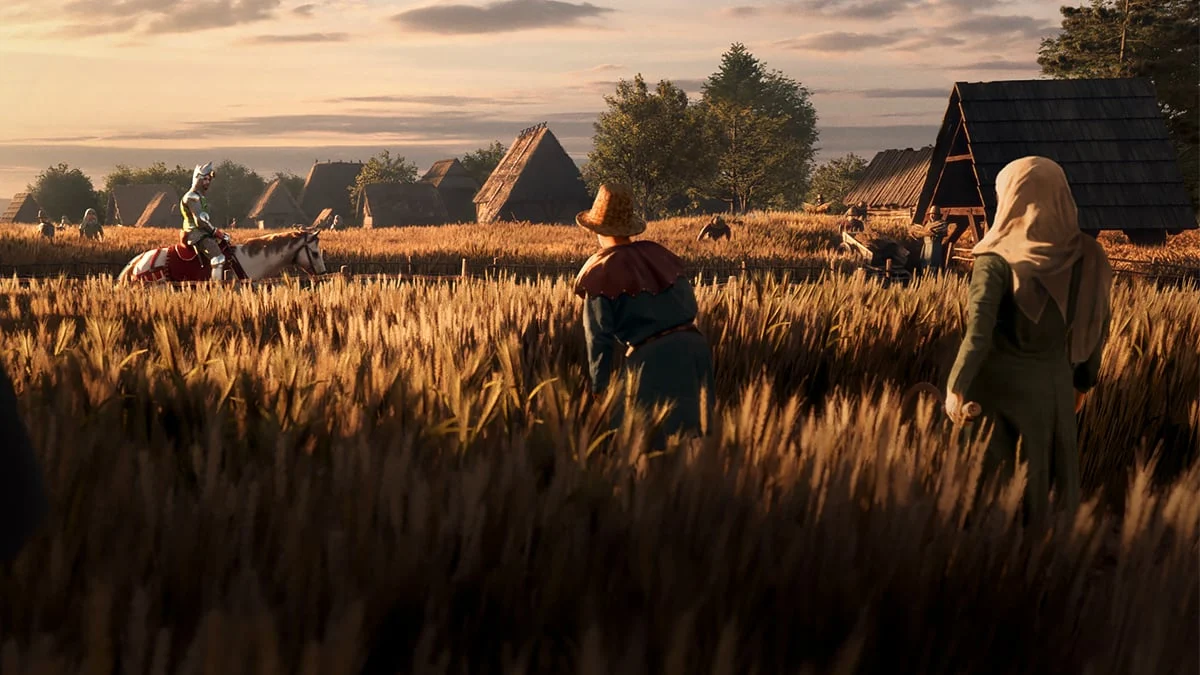
Farming stands as the unequivocal cornerstone of any thriving settlement in Manor Lords, providing not only the fundamental sustenance for digital villagers but also the essential ingredients for their leisure and economic prosperity. From preventing widespread starvation during harsh winters to fueling the production of morale-boosting ale, a robust agricultural system is paramount for long-term survival and expansion. This guide delves into the intricate mechanics of farming, offering strategic insights to cultivate a flourishing medieval manor.
The Foundation of Sustenance: Wheat Cultivation (Emmer)
In the nascent stages of any Manor Lords settlement, the immediate and overriding priority must be the cultivation of wheat. Designated in-game as "Emmer," this ancient grain is not merely a food source; it is the lynchpin of early-game survival. As the initial population grows, the demand for bread escalates rapidly, making a consistent and abundant supply of wheat critical, particularly when bracing for the lean months of winter. The game’s realistic seasonal cycle dictates that no harvesting occurs during winter, necessitating a substantial surplus accumulated during the preceding autumn.
The decision by developer Slavic Magic to use the term "Emmer" instead of "Wheat" is a notable detail that reflects the game’s commitment to historical authenticity. Emmer, or Triticum dicoccum, is indeed an ancient species of hulled wheat, widely cultivated in the Near East and Europe during antiquity and the medieval period. While potentially causing momentary confusion for players expecting the more common "Wheat" nomenclature, this choice adds a layer of historical immersion, introducing players to period-specific terminology that accurately reflects the agricultural landscape of the era. This design philosophy underscores the developer’s intent to create a historically grounded simulation rather than a simplified, anachronistic experience.
The journey from planted Emmer to a villager’s loaf of bread involves a crucial production chain. Farmers, assigned to a Farmhouse, meticulously sow and harvest the grain. Once harvested, the raw wheat must be transported to a Windmill, where it is milled into flour. This flour, in turn, is then taken to a Communal Oven or a Bakery, where it is finally baked into bread, ready for distribution to the populace. Each step in this chain requires functional buildings and assigned workers, highlighting the interconnectedness of early-game infrastructure. A bottleneck at any point – be it insufficient farmers, a lack of windmills, or an overwhelmed bakery – can quickly lead to food shortages and, consequently, a decline in public order and population health.
Diversifying the Harvest: Barley, Flax, and Rye
While wheat forms the bedrock of survival, a sustainable and prosperous manor requires agricultural diversification. Beyond mere sustenance, crops like barley, flax, and rye introduce additional economic, social, and strategic layers to the farming simulation.
-
Barley: Once a stable wheat supply is secured, players should strategically pivot to cultivating barley. This grain is indispensable for the production of ale, a commodity with significant social and economic implications. Ale is not just a luxury; it is a vital component of villager morale and approval. A well-supplied tavern, offering regular access to ale, significantly contributes to the happiness and loyalty of the populace, reducing the likelihood of discontent and bolstering overall productivity. The production chain for ale mirrors that of bread in its complexity: barley is first processed into malt at a Malt House, then brewed into ale at a Brewery. The economic benefits extend beyond local consumption, as surplus ale can become a valuable trade good, generating regional wealth for the settlement.
-
Flax: Cultivation of flax introduces a different dimension to the settlement’s economy – textile production. Flax is processed into linen, which can then be used to craft clothing. Providing clothing to villagers not only meets a basic need but also contributes to their comfort and overall approval. Furthermore, linen and finished clothing items can be significant export goods, offering another avenue for generating regional wealth and supporting a more complex trade network. The ability to produce textiles locally reduces reliance on external trade for essential goods, enhancing the settlement’s self-sufficiency.
-
Rye: While not explicitly detailed in the original content beyond its fertility indicator, rye typically serves as an alternative grain crop in historical simulations. It is often more resilient to poorer soil conditions or harsher climates than wheat, making it a strategic choice for fields with lower Emmer fertility. Rye can be milled into flour for bread, providing a valuable backup or alternative food source, especially in regions where wheat struggles to thrive. Its inclusion signifies the importance of adapting crop choices to specific land characteristics.
The Mechanics of the Land: Understanding Soil Fertility
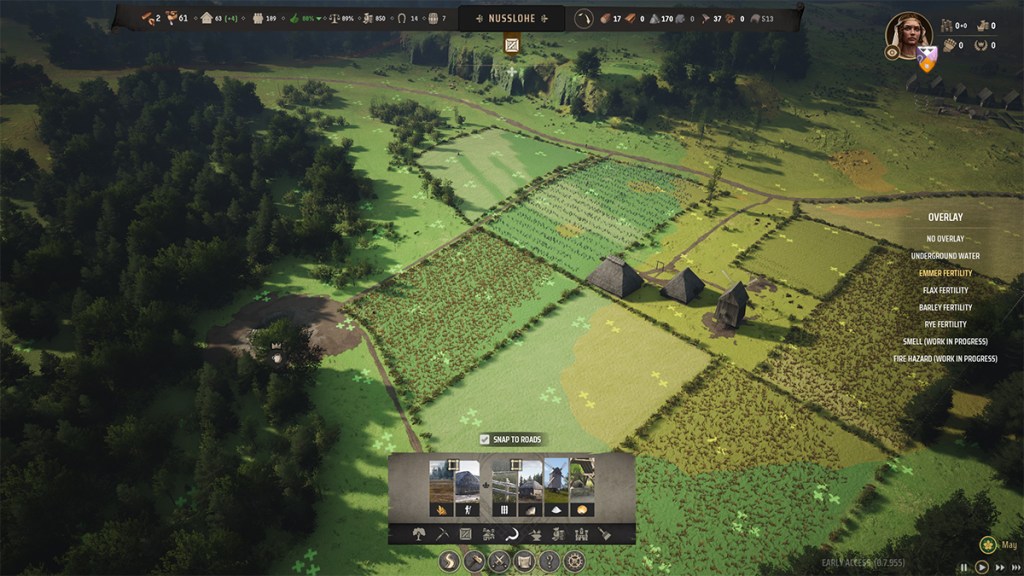
Central to effective farming in Manor Lords is a deep understanding of the game’s soil fertility system. This mechanic introduces a layer of realism and strategic planning, mirroring historical agricultural challenges. Within the Construction menu, under the "Farming" tab, players can toggle fertility indicators for Emmer, Flax, Barley, and Rye. This feature overlays the map with a color-coded visual representation of the land’s suitability for each crop: bright green indicates highly fertile ground, ideal for cultivation, while shades of orange and red denote increasingly infertile areas that should be avoided for that specific crop.
This fertility is not static. Repeated cultivation of the same crop on the same plot of land will inevitably lead to soil degradation. Each harvest extracts nutrients from the soil, diminishing its productive capacity over time. Neglecting this vital aspect of land management will result in progressively smaller yields, eventually rendering fields unproductive and jeopardizing the settlement’s food security. The system forces players to engage with the environmental realities of medieval agriculture, where sustainable practices were not merely a choice but a necessity.
Strategic Agricultural Management: Crop Rotation and Field Optimization
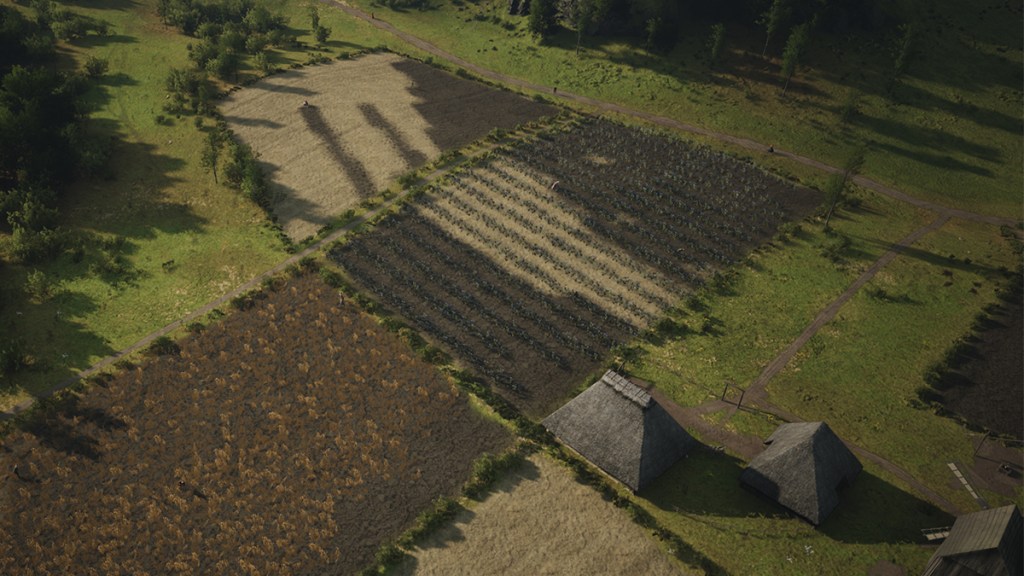
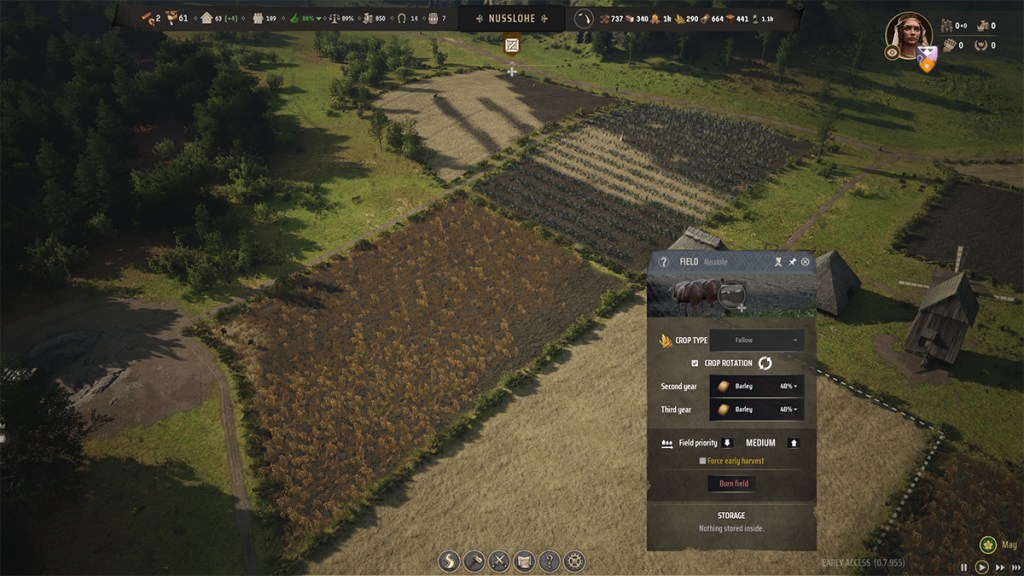
To counteract soil degradation and ensure long-term agricultural viability, Manor Lords integrates a crucial mechanic: crop rotation. This system allows players to schedule a field’s growing cycle over a three-year period, a historical practice designed to maintain soil health. The most effective strategy involves incorporating a fallow period, where a field is left unplanted for at least one year within the three-year cycle. During this fallow year, the soil naturally replenishes its nutrients, restoring its fertility for subsequent planting cycles.
Players can also utilize fallow fields for pasture, allowing livestock (such as sheep or oxen, if available in the game’s mechanics) to graze. This practice provides a dual benefit: the animals fertilize the land with their waste, further enhancing soil recovery, while also potentially providing wool or meat resources. The implementation of a three-field system—one field for a primary crop (e.g., wheat), one for a secondary crop (e.g., barley or rye), and one left fallow or used for pasture—is a historically accurate and strategically sound approach to managing land fertility and maximizing overall output.
Field sizing and worker efficiency are also critical considerations. The game measures land in "morgen," an archaic unit of land measurement historically used in parts of Europe, roughly equivalent to the amount of land that could be ploughed by a man with an ox in a morning. While a tooltip often advises creating fields of approximately one morgen, the actual efficiency of a single family assigned to farming is about two-thirds of a morgen per year. This means that to effectively manage a one-morgen field and account for the necessary fallow periods, multiple families or a larger, more strategically designed farm layout are required. For sustainable production, especially with crop rotation, a minimum of three fields (e.g., two for active cultivation and one for fallow/pasture) is highly recommended for each primary crop type to ensure continuous yields without depleting the soil.
Essential Agricultural Infrastructure
A successful farming operation in Manor Lords relies on a network of interdependent structures that facilitate the entire production chain from seed to finished product.
- Farmhouse: This is the primary building for all farming operations. Villagers assigned to a Farmhouse will manage the fields, sowing seeds, harvesting crops, and transporting raw materials. Its placement relative to fields and processing buildings is crucial for minimizing travel time and maximizing efficiency.
- Windmill: Essential for converting harvested grain (wheat/Emmer, barley, rye) into flour or malt. Multiple windmills may be necessary as the settlement grows and grain production increases to prevent bottlenecks in the food supply chain.
- Communal Oven/Bakery: These structures are where flour is transformed into bread. A Communal Oven is typically an early-game, shared facility, while a dedicated Bakery might represent a more advanced, efficient production unit.
- Malt House & Brewery: For ale production, a Malt House processes barley into malt, which is then taken to a Brewery to be fermented into ale. These buildings are key to meeting the villagers’ demand for beverages and contributing to morale.
- Weaver’s Shop: While not directly agricultural, the Weaver’s Shop is the destination for harvested flax, where it is spun into linen. This completes the flax production chain, providing essential clothing materials and potential trade goods.
Advancing Agricultural Prowess: Development Points and Upgrades
As a settlement grows and Burgage Plots are upgraded, players earn Development Points. These points can be strategically invested in various skill trees, one of which directly enhances agricultural efficiency and output. The Agricultural Development Tree offers a suite of upgrades designed to improve different facets of farming:
- Heavy Plow: This upgrade could allow for faster plowing of fields, increasing the speed at which new fields are prepared or existing ones are managed, leading to more efficient use of the growing season.
- Fertilization: Potentially an upgrade that allows farmers to use animal manure or other fertilizers to more rapidly restore soil fertility during fallow periods, or even increase yields on actively cultivated land. This would reduce the reliance on natural regeneration alone.
- Advanced Husbandry: This might improve the efficiency of managing livestock on pasture fields, leading to better soil fertilization or increased output of animal products (e.g., more wool from sheep on fallow fields).
- Improved Storage Techniques: While not directly a farming action, better storage (e.g., granaries) could reduce spoilage, ensuring more of the harvest makes it to the villagers, effectively increasing net yield.
- Field Management Expertise: This could be an upgrade that slightly increases the effective working capacity of families on fields, allowing them to manage larger areas or produce more per morgen.
Strategic investment in these development options can significantly scale agricultural production, enabling larger populations to be fed and more resources to be generated for trade and advanced manufacturing. Each point spent should align with the settlement’s current needs and long-term expansion goals.
The Broader Impact: Economic, Social, and Strategic Implications
Farming in Manor Lords transcends simple resource gathering; it is deeply interwoven with the economic, social, and strategic fabric of the entire settlement.
- Economic Stability: A robust agricultural sector provides not only staple foods but also valuable trade goods like surplus grain, ale, linen, and possibly even livestock products. This creates a stable internal economy and generates regional wealth through trade routes, allowing for the acquisition of resources not locally available and funding further development.
- Social Harmony: The direct link between food security and villager morale is undeniable. A well-fed populace is a content populace, less prone to dissent and more productive. The availability of ale further boosts approval, reducing crime and unrest. Conversely, food shortages lead to starvation, disease, and ultimately, a breakdown of social order.
- Population Growth: Sustained food and resource production are prerequisites for attracting new families and upgrading Burgage Plots. Without a reliable agricultural base, population growth will stall, limiting the settlement’s ability to expand and advance.
- Long-Term Sustainability: The soil fertility and crop rotation mechanics emphasize the importance of sustainable resource management. Neglecting these aspects can lead to environmental degradation within the game’s context, making future expansion more challenging and costly. Players are implicitly taught the value of balancing immediate needs with long-term ecological health.
Developer’s Vision and Historical Authenticity
The detailed and nuanced farming system in Manor Lords reflects Slavic Magic’s overarching vision for the game: to provide a historically authentic and strategically deep city-builder experience. The integration of period-accurate terminology like "Emmer" and "morgen," alongside mechanics such as soil degradation and crop rotation, immerses players in the realities of medieval life. This commitment to realism ensures that farming is not a trivial background activity but a challenging and rewarding core mechanic that demands careful planning, adaptation, and foresight. It’s a testament to the game’s design that players are encouraged to think like medieval lords, understanding the fundamental importance of the land and its yield.
Conclusion
Farming in Manor Lords is far more than just planting seeds; it is a complex and vital system that underpins every aspect of settlement development. From the initial struggle for survival with wheat cultivation to the strategic diversification into barley and flax, and the intricate management of soil fertility through crop rotation, every decision made on the farm has cascading effects throughout the manor. By mastering these agricultural principles, understanding the land, and strategically investing in infrastructure and development, players can transform a fledgling camp into a sprawling, prosperous medieval domain, where both sustenance and merriment are abundant. The fields, stretching to the horizon, thus become not just a source of food, but a testament to thoughtful planning and sustainable governance.