

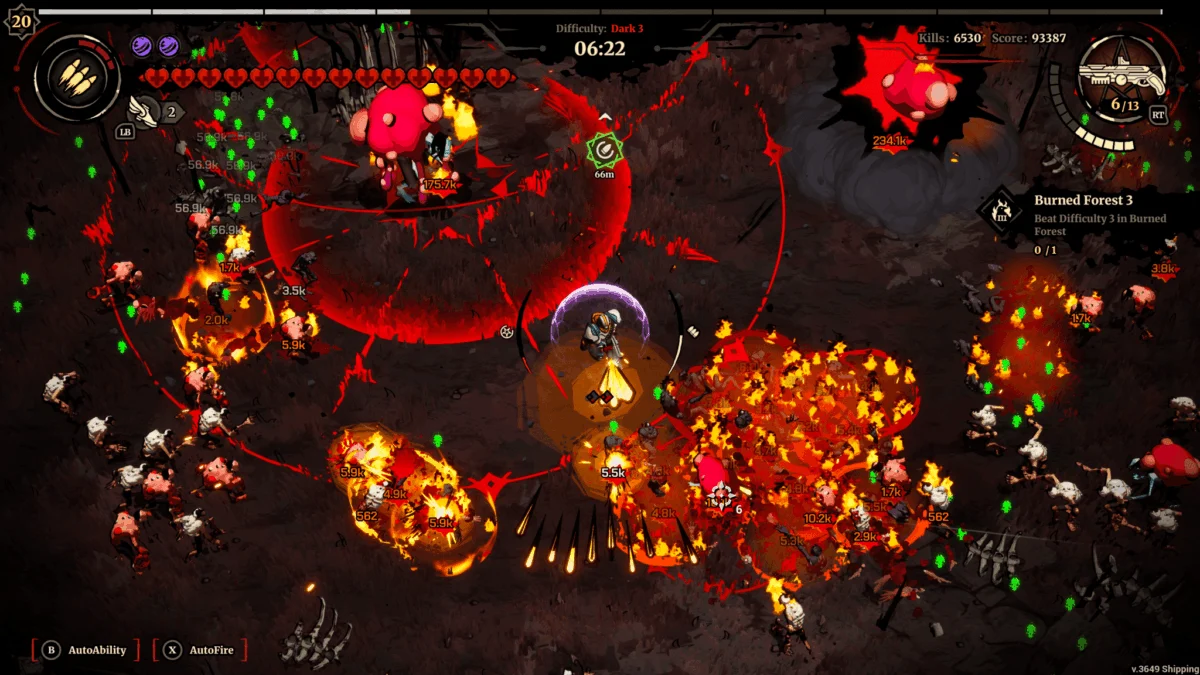
Grind Survivors represents the latest entry in the burgeoning "bullet heaven" or "survivors-like" subgenre, arriving on the Xbox Series X to challenge the dominance of established titles through a specific focus on high-fidelity 3D visuals and a complex loot-based progression system. Developed by Pushka Studios and published by Assemble Entertainment, the title seeks to bridge the gap between the hyper-casual accessibility of early genre pioneers and the mechanical depth of traditional action role-playing games (ARPGs). By integrating a "Diablo-lite" equipment forge with the chaotic, wave-based survival mechanics popularized over the last three years, the game attempts to carve out a niche for players seeking a more substantial "grind" than its predecessors typically offer.
The emergence of the bullet heaven genre—characterized by top-down perspectives, automated weapon fire, and exponential power scaling—has seen a rapid evolution since 2022. Grind Survivors enters this competitive landscape by emphasizing technical performance on current-generation hardware, specifically utilizing the processing power of the Xbox Series X to manage the dense particle effects and high enemy counts that define the experience. Unlike the 2D pixel-art aesthetics of its contemporaries, this title utilizes a fully 3D engine, delivering a visual experience that mirrors the intensity of modern dungeon crawlers while maintaining the core "one-stick" movement philosophy of the survivors-like movement.
The Evolution of the Bullet Heaven Genre and Market Context
To understand the positioning of Grind Survivors, one must look at the chronology of the survivors-like phenomenon. The genre saw its mainstream breakout with the success of Vampire Survivors in early 2022, which prioritized simple mechanics and retro aesthetics. This was followed by a second wave of titles such as Halls of Torment and Soulstone Survivors, which introduced more complex meta-progression and varied art styles. Grind Survivors represents a third-wave iteration where the focus shifts toward "loot-chasing" and high-end graphical fidelity.
Industry data suggests that the survivors-like genre has become one of the most cost-effective and popular segments for independent and mid-tier publishers. These games offer high replayability through procedural generation and incremental upgrades, making them ideal for console ecosystems like Xbox Game Pass or digital storefronts. Assemble Entertainment’s decision to bring Grind Survivors to the Xbox Series X highlights a strategic move to capture a console audience that values smooth frame rates and high-definition spell effects, which are often compromised in mobile or low-spec PC ports of similar games.

Core Gameplay Mechanics and Technical Architecture
The gameplay loop of Grind Survivors adheres to the established genre pillars while introducing several distinct layers of complexity. Upon entering a match, players are dropped into one of several "Hellish battlegrounds" where the primary objective is survival against an ever-increasing horde of demonic entities. The initial minutes of a run are characterized by deliberate, slow-paced combat as players utilize a single weak attack to harvest experience points (XP) from fallen foes.
As XP is collected, the player levels up, triggering a selection of randomized perks, active abilities, and passive boosts. The technical achievement of Grind Survivors on the Xbox Series X is most evident during the mid-to-late game "power creep." The game’s engine is optimized to handle hundreds of simultaneous projectiles and thousands of enemy units without significant frame rate drops—a common hurdle for 3D survivors-like titles. Players can stack hundreds of incremental power-ups, creating synergies that result in screen-filling explosions and automated "bullet hell" patterns directed toward the enemy.
The game differentiates itself through "active" mechanics. While many titles in this genre are purely passive, Grind Survivors incorporates manual dashes and activated abilities that require precise timing to avoid "hit indicators"—large red zones on the ground that signal devastating enemy attacks. This shifts the gameplay from a purely mathematical check of stats to a more skill-based encounter, particularly during boss fights and elite enemy spawns.
The Loot System: Merging Roguelikes with ARPGs
Perhaps the most significant departure from the standard survivors-like formula is the inclusion of a robust, permanent loot system. While games like Vampire Survivors focus on permanent stat upgrades via gold, Grind Survivors introduces a weapon-based economy akin to traditional looter-shooters. During gameplay, players can find firearms and melee weapons of varying rarities, from common to legendary.
The "Forge" serves as the central hub for meta-progression. Here, the game adopts mechanics familiar to players of the Diablo or Path of Exile series:

- Item Fusion: Players can combine multiple low-tier items to create higher-rarity gear.
- Stat Rerolling: Individual attributes on a weapon can be randomized to better suit a specific character build.
- Statistical Overclocking: Players can push gear stats beyond their standard limits, though this carries a risk-reward mechanic where a failed upgrade can result in the loss of previous enhancements.
This system provides a long-term incentive that extends beyond the 20-to-30-minute duration of a single run. The inclusion of unique weaponry, such as Tesla guns, high-velocity SMGs, and enchanted swords, allows for a variety of playstyles that are further modified by the character class selected.
Progression Hurdles and Content Distribution
Despite the mechanical depth of its combat and loot systems, Grind Survivors has faced scrutiny regarding its progression pacing and content density. At launch, the game features four distinct character classes and three primary maps. However, much of this content is gated behind a rigorous difficulty-based unlock system.
Analysis of the progression timeline reveals a significant "time-to-unlock" requirement:
- Map Unlocks: To access the second map, a player must typically complete the first map across five escalating difficulty tiers. Estimates suggest this process can take upwards of 10 hours of gameplay.
- Character Unlocks: The secondary and tertiary characters are similarly locked behind high-difficulty milestones, with some not becoming available until the fourth or fifth difficulty tier is mastered.
- Weapon Variety: The most mechanically interesting weapons are often found deep into the game’s progression tree, meaning early-game players may experience a more repetitive version of the loop before reaching the title’s true potential.
This design choice has been a point of contention among the player base. While it ensures that players master the mechanics of each stage, it risks alienating those who prefer the rapid-fire content delivery typical of the roguelike genre. Furthermore, the reliance on "perfect builds"—specific combinations of health-doubling perks and defensive shields—to survive higher difficulty tiers suggests a need for further balance tuning to ensure build diversity remains viable at the endgame.
Official Responses and Post-Launch Trajectory
In statements regarding the game’s launch and future, representatives from Pushka Studios have emphasized their commitment to an iterative development cycle. While no formal roadmap has been published, the developers have acknowledged the need for balance adjustments and have hinted at the addition of new maps and classes in future updates.

The "infinite version" of stages, which allows players to compete for high scores on global leaderboards after the natural endpoint of a run, is intended to be the primary driver for community engagement. By focusing on "score-chasing," the developers hope to sustain a competitive scene that encourages players to optimize their loot and perk synergies to the absolute limit.
Technical glitches, though rare, have been noted by the community, including instances where the game fails to pause correctly during upgrade selection screens. The development team has signaled that stability patches are a priority to ensure the Xbox Series X version remains the definitive console experience.
Broader Impact and Implications for the Industry
The release of Grind Survivors on a high-end console like the Xbox Series X signifies the maturing of the bullet heaven genre. It proves that there is a market for "premium" survivors-like games that move away from low-fidelity aesthetics in favor of complex systems and modern graphics.
For the broader industry, the success or failure of titles like Grind Survivors will likely dictate how much "ARPG DNA" is injected into future roguelikes. If players respond well to the loot-grind and forge mechanics, it could signal a shift where the line between "Survivors-like" and "Action RPG" becomes increasingly blurred.
Grind Survivors currently stands as a mechanically sound, visually impressive, yet content-gated entry in a crowded market. Its emphasis on stacking buffs, infinite scaling, and a Diablo-style loot chase offers a compelling reason for genre fans to transition from 2D sprites to 3D demon-slaying. However, its long-term viability will depend on how the developers address the slow unlock pace and whether they can provide enough environmental and enemy variety to match the depth of the game’s mechanical systems. As it stands, the title is a testament to the genre’s evolution, offering a "grind" that is as rewarding as it is demanding for those willing to invest the time to unlock its secrets.