

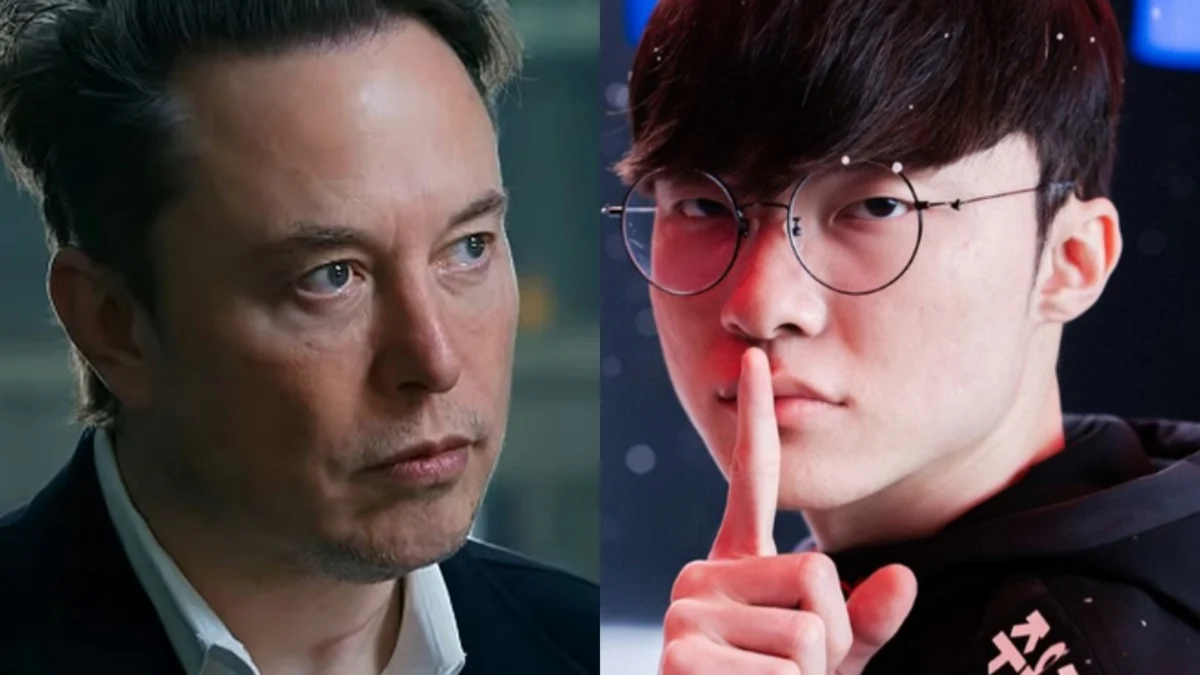
In a move that has sent ripples through the global esports and artificial intelligence communities, billionaire entrepreneur Elon Musk has officially challenged the legendary League of Legends team T1, and its iconic mid-laner Lee Sang-hyeok, widely known as Faker, to a competitive match against his advanced AI, Grok. This audacious proposition, announced via Musk’s social media platform X, marks a significant escalation in the ongoing exploration of AI’s capabilities within complex strategic gaming environments and draws a direct parallel to historical human-versus-machine intellectual contests. The proposed showdown, slated for 2026, aims to pit the pinnacle of human League of Legends prowess against a cutting-edge AI designed to learn and adapt.
Musk’s long-standing fascination with artificial intelligence and its potential to revolutionize the gaming industry has been well-documented. He has previously voiced ambitions to establish his own AI game studio, expressing a firm belief that AI could not only contribute to game development but, by 2029, potentially create entire video games autonomously. This latest challenge represents a tangible step in that direction, seeking to test Grok’s strategic acumen, rapid decision-making, and adaptability in one of the world’s most popular and intricate esports titles. The comparison to the seminal 1997 chess match between IBM’s Deep Blue and World Champion Garry Kasparov is apt, signifying a potential watershed moment in the evolution of human-AI competition.
The Genesis of the Challenge: Musk’s Vision for Grok in Gaming
Elon Musk unveiled his vision for Grok 5, an iteration of his AI model, detailing its capacity to engage with and master any game simply by processing its rules and engaging in experimental play. In a series of posts on X, Musk articulated the core of his challenge: "Let’s see if Grok 5 can beat the best human team League Of Legends in 2026 with these important constraints." This statement immediately ignited widespread interest, underscoring Musk’s conviction in Grok’s potential.
The proposed constraints are critical to framing the competition as a fair test of AI versus human skill, rather than a technological mismatch. Musk outlined two key limitations designed to level the playing field:
- Visual Input Limitation: Grok would be restricted to observing the game solely through a camera feed, simulating the visual acuity of a human with 20/20 vision. This prevents the AI from having an omniscient or enhanced view of the game state.
- Human-Level Reaction and Input Speed: The AI’s reaction latency and click rate would be capped to match that of a human player. This addresses the inherent advantage AI can possess in terms of processing speed and input execution, ensuring that T1 and Faker would not be competing against a machine capable of impossibly fast reflexes.
These stipulations are designed to isolate Grok’s strategic thinking and learning capabilities, removing the artificial advantages that raw computational power might otherwise afford. The target year of 2026 suggests a timeline for Grok’s development and training, allowing ample time for it to absorb the complexities of League of Legends.
T1 and Faker: The Apex of League of Legends Prowess
The choice of T1 and Faker as the human counterparts is hardly coincidental. T1, formerly SK Telecom T1, is arguably the most storied and successful organization in League of Legends history, boasting a record four World Championship titles. Faker, often hailed as the "Greatest of All Time" (GOAT) in League of Legends, has been a dominant force in the game for over a decade, renowned for his exceptional mechanics, unparalleled game sense, and consistent clutch performances. His career achievements, including multiple MVP awards and a legendary status within the esports pantheon, make him the ultimate benchmark for any competitive challenge.
The prospect of Faker, the embodiment of human skill and strategic depth in League of Legends, facing off against an AI like Grok has captured the imagination of fans worldwide. This encounter transcends a mere esports match; it represents a philosophical debate about the future of intelligence, creativity, and competition in the digital age.
Industry Reactions: A Mix of Skepticism and Intrigue
Elon Musk’s announcement quickly garnered significant attention from prominent figures within the esports and AI research communities. The implications of such a match have sparked discussions, with reactions ranging from enthusiastic endorsement to cautious skepticism.

Support and Speculation from Esports Veterans:
Former professional League of Legends player Eugene "Pobelter" Park expressed keen interest, offering his expertise. He tweeted, "Would love to help and offer insight as a former League pro, I thought AI vs Dota 2 was really interesting and always wanted to see it vs League." This sentiment highlights a desire within the professional scene to explore the AI versus human dynamic in esports.
Oriol Vinyals, a researcher known for his work in AI and gaming, particularly his success in achieving Grandmaster status in StarCraft, piqued Musk’s interest with a playful suggestion. Vinyals proposed that Musk’s AI could also be tested in Blizzard’s iconic real-time strategy game, StarCraft, adding, "Bonus points if you get the robots to operate the mouse and keyboard." Musk’s simple reply, "Sounds good," suggests an openness to further AI gaming challenges.
Skepticism Regarding AI’s Current Capabilities:
However, not all reactions were as optimistic. Several high-profile former players voiced doubts about Grok’s ability to compete at the highest level by 2026, particularly under the stipulated constraints.
Joedat "Voyboy" Esfahani, a renowned former League of Legends professional, articulated his reservations, stating, "You wouldn’t even be able to beat an LCS team, much less Faker and the boys. League has far too many variables / interaction & game knowledge context / legit team coordination required to win at the highest level." His argument points to the intricate teamwork, meta-knowledge, and complex decision-making inherent in League of Legends, which he believes are exceptionally difficult for current AI to replicate.
Yiliang "Doublelift" Peng, another prominent former League of Legends pro and popular streamer, echoed similar sentiments. He expressed extreme doubt about Grok’s chances against T1 or even himself, going so far as to pledge to shave his head if Grok managed to defeat him. This bold statement underscores the perceived gap between current AI capabilities and the nuanced, human-driven strategies employed by top-tier esports athletes.
Official Responses: T1 and Riot Games Engage
The official responses from T1 and Riot Games, the developer and publisher of League of Legends, indicate a significant level of interest and potential engagement.
T1 responded directly to Elon Musk’s challenge with a confident and spirited declaration: "We are ready," accompanied by a GIF of Faker. They followed up with a direct question to Musk: "Are you?" This response signals T1’s willingness to accept the challenge and underscores their belief in their own formidable capabilities.

The potential for this match to become a major event has also attracted the attention of Riot Games. Marc Merrill, co-founder and president of Riot Games, replied to Musk’s post with a simple yet powerful "let’s discuss." This suggests that Riot Games is open to the idea of officially sanctioning, promoting, or perhaps even broadcasting such a match, potentially elevating it to one of the most anticipated League of Legends events in history. The involvement of Riot Games could provide the necessary infrastructure and platform for a high-stakes, widely viewed competition.
Broader Implications: The Future of AI in Esports and Beyond
The proposed match between Grok and T1, spearheaded by Elon Musk, carries profound implications that extend far beyond the realm of competitive gaming. It serves as a powerful symbol of humanity’s ongoing quest to understand and integrate artificial intelligence into all facets of life, including areas previously considered the exclusive domain of human intellect and skill.
Advancements in AI Development:
If Grok, under the specified constraints, can demonstrate a competitive capability against a team like T1, it would represent a monumental leap in AI’s ability to grasp and execute complex, dynamic strategies. This would validate Musk’s vision for AI’s role in gaming and potentially accelerate research into AI applications in other strategic domains, such as complex logistics, financial trading, or even scientific discovery. The data generated from such a competition would be invaluable for refining AI learning algorithms and developing more sophisticated predictive and adaptive models.
The Evolution of Esports:
The integration of AI into esports, whether as competitors or sophisticated training tools, could fundamentally alter the landscape of professional gaming. AI-powered analytics could provide players and teams with deeper insights into opponent strategies, optimal playstyles, and predictive outcomes. While the idea of AI directly competing against human teams is still nascent, this challenge opens the door to a future where AI might play a more integrated role in the esports ecosystem, perhaps even developing its own unique strategies that push human players to new levels of innovation.
Ethical and Philosophical Considerations:
As AI systems become more capable, questions surrounding their role in human endeavors become increasingly important. A match between Grok and T1 would inevitably spark debates about the definition of intelligence, the nature of competition, and the unique value of human creativity and intuition. It forces us to consider how we define victory and mastery when one participant is an artificial entity.
Historical Parallels and Future Trajectories:
The shadow of Deep Blue vs. Kasparov looms large over this proposed challenge. That event marked a turning point in the perception of AI’s intellectual capabilities. A successful AI performance against T1 in League of Legends could similarly redefine public and expert understanding of AI’s potential in areas requiring strategic foresight, rapid adaptation, and complex pattern recognition. It signals a future where the boundaries between human and artificial intelligence in creative and competitive fields are increasingly blurred.
While the outcome remains uncertain and the logistical details are still to be finalized, the mere prospect of Elon Musk’s Grok AI challenging T1 and Faker has already ignited a global conversation. This potential clash represents more than just a gaming spectacle; it is a glimpse into a future where artificial intelligence is not just a tool, but a formidable competitor and collaborator in the most complex human arenas. The world will undoubtedly be watching to see if Grok can indeed ascend to the pinnacle of League of Legends, challenging the reign of human champions.