

The Core Mechanics of Dice A Million
At its fundamental level, Dice A Million is a game of probability management and score optimization. The objective is deceptively simple: players are tasked with throwing various dice to meet or exceed a predetermined score threshold. However, the complexity arises from the diversity of the "dice" themselves. Unlike a standard set of six-sided cubes, the game introduces a variety of objects that function as randomized generators, including piggy bank dice, bottle caps, and "death stars."
Each object possesses unique properties and scoring potential. For instance, bottle caps may offer lower base values but provide economic advantages, such as discounts in the in-game shop. This mechanical variety forces players to pivot their strategies based on the tools available in their current run. The act of rolling is streamlined; the game eschews complex physics-based interactions in favor of a single-button "roll" command. Once triggered, the dice are deployed into a square play area, and the results are tallied based on their landing positions and inherent values.
Progression Systems and the "Pips" Economy
The game’s structural framework follows a strictly defined rogue-lite loop. A standard run is divided into rounds, with a boss encounter occurring every four rounds. To progress, players must navigate through different "hands" or sets. Each hand type introduces a specific constraint or bonus. For example, a "green hand" might grant the player seven dice per roll instead of the standard five, while a "red hand" might focus exclusively on bottle caps with low scoring potential but high utility.

A critical component of the gameplay is the "Pip" system. In Dice A Million, every point earned—referred to as a "pip"—serves as a dual-purpose resource. Pips are not merely a score to be reached; they function as the game’s primary currency. Accumulated pips can be carried over from one round to the next, allowing players to spend them in the shop to acquire new dice or passive items. Alternatively, players can choose to "skip" rounds by paying a pip premium, a strategic choice that balances the need for immediate upgrades against the risk of entering a boss fight under-geared.
However, the transition to a boss round introduces a significant difficulty spike. Upon reaching a boss, all previously earned pips are discarded, and the player is subjected to a random passive negative modifier. These modifiers can range from score penalties to restrictions on specific dice types, necessitating a robust "build" that can withstand unpredictable debuffs.
The Role of Rings and Passive Synergies
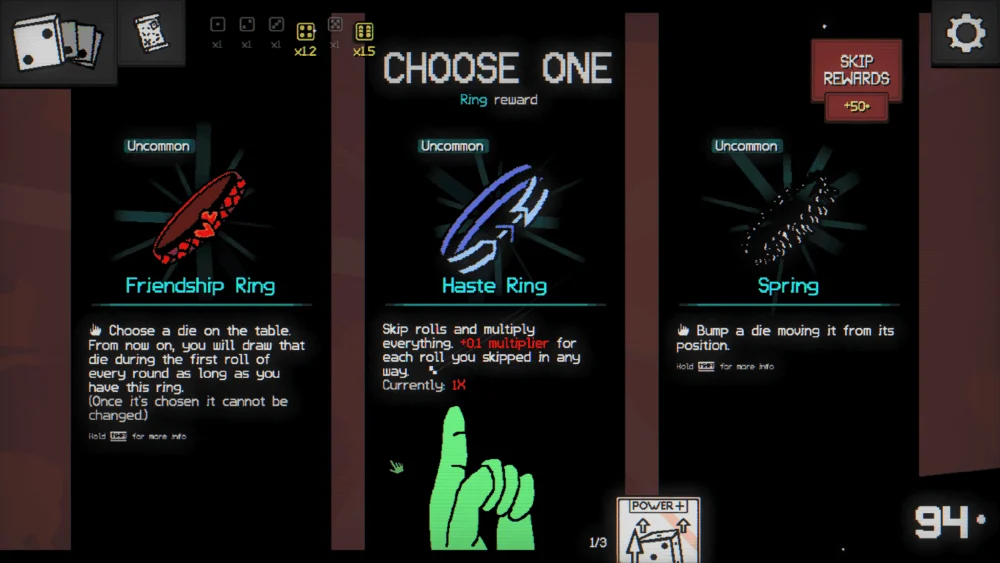
Much like the "Joker" cards in Balatro, Dice A Million utilizes "Rings" as the primary source of passive buffs and game-altering synergies. These rings are the backbone of any successful run, providing the multipliers and score boosters necessary to reach the "ludicrous amounts of points" the game encourages.
The strategy lies in the interaction between these rings and the specific dice in a player’s inventory. Some rings might trigger additional points when a specific shape of die is rolled, while others might provide a global multiplier for every consecutive successful roll. One notable mechanic involves player agency regarding die positioning. While the game generally lacks direct control over where dice land, certain rings allow players to "bump" or reposition a die before the final score is tallied. This represents one of the few moments of tactile interaction in an otherwise RNG-heavy (random number generation) experience.

Visual Identity and "Squigglevision" Influence
Dice A Million distinguishes itself through a unique aesthetic choice that pays homage to late 90s and early 2000s adult animation. The visual style is reminiscent of "Squigglevision," a technique popularized by shows like Dr. Katz, Professional Therapist and Home Movies. This style features jittery, constantly moving outlines that give the static images a sense of perpetual motion.
The user interface is intentionally crude but functional, featuring hand-drawn rings, basic card layouts, and stilted animations of hands. This lo-fi approach contrasts with the high-octane numerical explosions that occur during a successful roll. The narrative premise—that the player has been hired for a "weird ass job" by a mysterious benefactor—is delivered through electronic chirps and humorous on-screen dialogue, reinforcing the game’s quirky and somewhat irreverent tone.
Technical Performance and Platform Availability
From a technical standpoint, Dice A Million is optimized for a wide range of hardware. During performance testing on high-end gaming PCs, the title consistently reached frame rates in the hundreds, ensuring a smooth visual experience despite the "squiggly" nature of the art style. The game also demonstrates strong compatibility with Windows-based handheld devices, such as the ASUS ROG Ally X.
The integration with the Xbox ecosystem is a significant factor in the game’s launch strategy. As a "Day One" title on Game Pass, Dice A Million is positioned to reach a broad audience of subscribers who may be looking for a "pick-up-and-play" experience. The inclusion of cloud saves allows for seamless transitions between desktop and handheld play, a feature that is increasingly essential for the rogue-lite genre, which often favors short, repeatable sessions.

Market Analysis: The Rise of the "Balatro-like"
The release of Dice A Million marks a clear trend in the indie development scene: the emergence of the "Balatro-like." Following the massive commercial and critical success of LocalThunk’s poker-based rogue-lite, developers have begun exploring other traditional gambling or tabletop formats to see if they can capture the same addictive loop.
Industry analysts note that these games succeed by de-contextualizing gambling mechanics. By removing real-world financial risk and replacing it with in-game progression and power fantasies, developers can tap into the psychological appeal of "hitting the jackpot" without the ethical concerns of traditional gambling. Dice A Million’s use of dice—a universal symbol of chance—is a logical evolution of this trend.
Critical Analysis of Player Agency vs. Randomness
While Dice A Million has been praised for its "dopamine-inducing" gameplay, it faces a common critique within the genre: the balance between player skill and pure luck. In many rogue-lites, the player’s ability to manipulate the environment or execute precise movements can offset a bad run of luck. In Dice A Million, the player’s agency is largely confined to the "pre-roll" phase—selecting which rings to buy and which dice to keep.
Once the "roll" button is pressed, the outcome is almost entirely out of the player’s hands. This can lead to moments of frustration where a well-constructed build fails simply because the dice landed in an unfavorable configuration. However, the developers have attempted to mitigate this through the sheer volume of rolls and the speed of the game. A failed run can be restarted instantly, and the lessons learned about die and ring synergies carry over to the next attempt.

Chronology of Development and Release
The development of Dice A Million was characterized by a focus on "feel" and "feedback." Early devlogs indicated that the team spent a significant amount of time perfecting the sound effects and visual cues that accompany a high-scoring roll.
- Early 2025: Initial reveal of the "squiggly" art style and core dice-rolling concept.
- Mid 2025: Announcement of the partnership with Xbox for a Day One Game Pass release.
- Late 2025: Beta testing focused on balancing the "Rings" to ensure no single combination became game-breakingly dominant.
- February 25, 2026: Official launch on Steam and Xbox Game Pass.
Broader Impact and Industry Implications
The success or failure of Dice A Million will likely serve as a bellwether for the longevity of the "gambling-adjacent" rogue-lite. If the game maintains a steady player base, it will prove that the "Balatro formula" is adaptable to various themes and mechanics beyond playing cards.
Furthermore, the game’s inclusion in Game Pass highlights Microsoft’s continued strategy of bolstering its service with "high-engagement" indie titles. These games often have low overhead but high replayability, making them ideal for a subscription model where player retention is a key metric.
In conclusion, Dice A Million represents a polished, albeit familiar, addition to the rogue-lite genre. By combining a nostalgic art style with a modern, addictive gameplay loop, it offers a compelling experience for fans of strategy and chance alike. While it may not reinvent the wheel, its execution of the "one more roll" mentality makes it a noteworthy title for the 2026 gaming calendar. Whether players are seeking a deep strategic challenge or simply a quick hit of numerical escalation, Dice A Million provides a accessible entry point into the world of digital dice chucking.