


Pearl Abyss, the South Korean video game developer renowned for its expansive MMORPG titles, has officially detailed the anticipated performance specifications for its upcoming open-world action-adventure title, Crimson Desert, across a range of Xbox and handheld PC platforms. Set to launch globally on March 19th, the release of these technical specifications provides players with a crucial understanding of the visual fidelity and frame rate options available, underscoring the developer’s commitment to optimizing the experience across diverse hardware configurations. This comprehensive breakdown offers insights into how the game will leverage advanced technologies like AMD’s FidelityFX Super Resolution 3 (FSR 3) for enhanced performance and visual quality.
The unveiling of these modes comes as Crimson Desert approaches its highly anticipated release, marking a significant moment for the title that has garnered considerable attention since its initial reveal. Originally conceived as a prequel to Pearl Abyss’s flagship Black Desert Online, Crimson Desert evolved into a standalone, single-player focused experience, shifting its narrative and gameplay emphasis to a more character-driven adventure within the fantastical world of Pywel. The journey of the game through development has been closely watched by fans eager for a new, immersive open-world experience, and these performance details are a vital piece of the puzzle for prospective players.
Xbox Series X: A Spectrum of Visual and Performance Choices
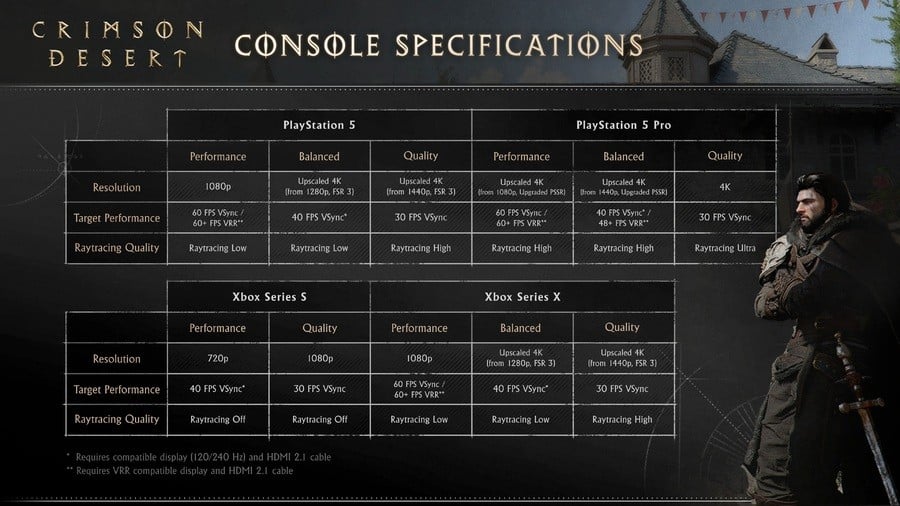
For players utilizing the flagship Xbox Series X console, Crimson Desert will offer three distinct performance modes, allowing for a tailored experience based on individual preferences for frame rate, resolution, and graphical fidelity. These modes – Quality, Balanced, and Performance – represent a strategic compromise between pushing visual boundaries and achieving smoother gameplay.
The Quality Mode is designed for players who prioritize visual fidelity above all else. In this setting, Crimson Desert targets a stable 30 frames per second (FPS) with VSync enabled, ensuring a consistent frame delivery without screen tearing. Resolution is a key highlight here, with the game rendering at an internal resolution of 1440p before being upscaled to a crisp 4K output, largely thanks to the integration of FSR 3 technology. Crucially, this mode also activates "Raytracing High," promising the most advanced lighting, shadow, and reflection effects available on the console, contributing significantly to environmental realism and immersion. The computational demands of high-quality ray tracing naturally necessitate the 30FPS target to maintain stability.

Moving to the Balanced Mode, Pearl Abyss aims for a middle ground, offering a noticeable bump in frame rate without severely compromising visual quality. This mode targets 40 FPS with VSync, providing a smoother experience than the Quality mode while still retaining a degree of graphical richness. The resolution strategy here involves an internal render of 1280p, which is then upscaled to 4K using FSR 3. Raytracing remains active in this mode, though at a "Raytracing Low" setting, indicating a slightly reduced complexity in ray-traced effects compared to the Quality mode, striking a balance between visual enhancement and performance. It is important to note that achieving a consistent 40FPS with VSync typically requires a display capable of a 120Hz or 240Hz refresh rate to properly display the non-standard frame rate.
Finally, the Performance Mode is tailored for players who demand the highest possible frame rates for the most responsive and fluid gameplay. This mode targets 60 FPS with VSync enabled, or even higher, often exceeding 60 FPS when paired with a Variable Refresh Rate (VRR) display. The resolution here is set at a native 1080p, with FSR 3 potentially used for further upscaling to higher display resolutions if desired. Similar to the Balanced mode, "Raytracing Low" is utilized, ensuring that some ray-traced enhancements are present without significantly impacting the core 60 FPS target. The emphasis here is squarely on maximizing frame rate, providing a highly responsive combat and exploration experience, which is often preferred in action-oriented open-world titles. Again, a 120Hz or 240Hz display is recommended for optimal enjoyment of the higher frame rates and to fully leverage VRR capabilities.
Xbox Series S: Optimized for Accessibility
The Xbox Series S, positioned as Microsoft’s more accessible current-generation console, presents unique optimization challenges for developers due to its lower computational power compared to the Series X. Pearl Abyss has addressed this by providing two distinct performance modes for Crimson Desert on the Series S: Performance and Quality.
The Performance Mode on Xbox Series S targets a 40 FPS experience, a commendable achievement for the console given the game’s graphical intensity. This mode operates at a native resolution of 720p, with FSR 3 likely employed for upscaling to fit higher resolution displays. As with its Series X counterpart, achieving the targeted 40 FPS optimally requires a 120Hz or 240Hz monitor to ensure smooth frame pacing.
The Quality Mode for the Series S prioritizes visual fidelity and resolution within the console’s capabilities, targeting a stable 30 FPS at a native 1080p resolution. This mode offers a more visually robust experience, albeit at a lower frame rate, catering to players who prefer a cinematic feel over raw performance on the Series S. The inclusion of these two modes demonstrates Pearl Abyss’s efforts to make Crimson Desert a visually pleasing and playable experience across both Xbox current-gen consoles, acknowledging the hardware differences and player expectations.

ROG Ally and Ally X: Handheld Power and Precision
The burgeoning market of handheld gaming PCs, exemplified by devices like the ROG Ally, presents another frontier for game optimization. Crimson Desert will also cater to these portable powerhouses, with specific performance presets for both the original ROG Ally and the more powerful ROG Ally X.
The newer ROG Ally X will benefit from three distinct performance modes, mirroring the versatility offered on the Xbox Series X. These modes will target 30 FPS, 40 FPS, and 60 FPS, respectively. The ability to achieve these varied frame rates on a handheld device is largely attributed to the robust integration of FSR 3 Super Resolution and its Frame Generation technologies. FSR 3’s ability to intelligently upscale lower internal resolutions and generate interpolated frames allows the Ally X to deliver a remarkably flexible and performant experience, enabling players to choose between visual fidelity and fluid gameplay on the go.
In contrast, the original ROG Ally will feature a single, optimized preset mode targeting 40 FPS. This streamlined approach reflects the slightly less powerful hardware of the original Ally, with the 40 FPS target likely representing the sweet spot for a balance of visual quality and playable performance on the device. The inclusion of dedicated handheld optimizations highlights the growing importance of this segment and Pearl Abyss’s intent to capture a wider audience.
The Critical Role of FSR 3: Advanced Upscaling and Frame Generation
A recurring and pivotal technology across all detailed performance modes is AMD’s FidelityFX Super Resolution 3 (FSR 3). This advanced upscaling and frame generation solution is central to Crimson Desert‘s ability to offer high resolutions and frame rates across a spectrum of hardware.
FSR 3 operates on two primary principles: spatial upscaling and frame generation. Spatial upscaling reconstructs a higher-resolution image from a lower-resolution input, intelligently filling in missing details using advanced algorithms. This allows the game to render at a lower, more performance-friendly resolution internally while outputting a sharper, higher-resolution image to the display.

The second, and perhaps more impactful, component of FSR 3 is its frame generation capability. This technology analyzes consecutive frames and, using motion vectors and other data, intelligently inserts interpolated frames between rendered frames. For instance, if a game is rendering at 30 FPS, FSR 3 can generate an additional frame between each rendered frame, effectively doubling the perceived frame rate to 60 FPS. While this doesn’t reduce input latency in the same way native rendering does, it significantly enhances visual smoothness, particularly in graphically demanding titles like Crimson Desert. The benefit is a much smoother visual experience without the raw computational cost of natively rendering every single frame at the target frame rate. This is particularly beneficial for the 40FPS and 60+FPS targets, especially on less powerful hardware like the Xbox Series S and ROG Ally devices, where native high frame rates might be unattainable without severe visual compromises.
Ray Tracing Implementation: Enhancing Environmental Realism
The inclusion of ray tracing across the Xbox Series X modes, even in a "Low" setting, signifies Pearl Abyss’s commitment to leveraging modern rendering techniques for enhanced visual realism. Ray tracing is a revolutionary rendering technology that simulates the physical behavior of light, creating hyper-realistic reflections, shadows, and global illumination.
In Crimson Desert‘s Quality Mode on Series X, "Raytracing High" will likely involve a more comprehensive application of ray-traced effects, potentially including more detailed global illumination for realistic light bouncing, accurate soft shadows, and highly reflective surfaces that mirror the environment with precision. This level of detail is computationally intensive, explaining its exclusive availability in the 30FPS Quality mode.
"Raytracing Low," present in the Balanced and Performance modes on Series X, typically implies a more selective application of ray-traced effects. This might mean ray-traced shadows for primary light sources, limited ray-traced reflections on specific surfaces, or a less frequent sampling of ray-traced global illumination. The goal is to provide a noticeable visual upgrade over traditional rasterization techniques without incurring the full performance penalty of a complete ray-tracing implementation. This tiered approach allows developers to integrate cutting-edge graphics while still offering viable performance options to a wider range of players and preferences.
Developer’s Philosophy: Balancing Performance and Aesthetics
The comprehensive array of performance modes across different platforms reflects a clear development philosophy from Pearl Abyss: to provide a highly customizable and optimized experience for Crimson Desert‘s diverse player base. In an era where hardware capabilities vary significantly, offering multiple options allows players to tailor their gameplay to their specific setup and priorities, whether they seek the highest possible visual fidelity, the smoothest frame rates, or a balanced compromise. This approach not only maximizes the game’s accessibility but also demonstrates the developer’s technical prowess in extracting performance from various systems while maintaining the game’s ambitious artistic vision. It acknowledges that an open-world action-adventure game benefits immensely from both stunning visuals for immersion and high frame rates for responsive combat and exploration.
Anticipation and Independent Verification: The Digital Foundry Factor
With the official release date of March 19th fast approaching, the gaming community, particularly those invested in technical analysis, is eagerly awaiting independent verification of these stated performance targets. Digital Foundry, a respected authority in technical game analysis, has already confirmed its intent to rigorously examine the console versions of Crimson Desert as soon as possible. Their reports are invaluable, providing detailed breakdowns of actual frame rates, resolution scaling accuracy, consistency of ray-tracing effects, and any potential issues such as frame pacing irregularities or input latency. This independent assessment will be crucial for players to make informed purchasing decisions and understand the real-world performance implications of each mode. Digital Foundry’s track record suggests that their upcoming analysis will be a definitive guide to how Crimson Desert truly performs across its various configurations.
Broader Implications for the Gaming Ecosystem
The detailed performance specifications for Crimson Desert carry broader implications for the current gaming landscape. Firstly, it underscores the growing trend of developers offering extensive graphical options on consoles, a feature historically more common on PC. This empowers console players with greater control over their gaming experience, moving away from a ‘one size fits all’ approach. Secondly, the heavy reliance on FSR 3 highlights the increasing importance of upscaling and frame generation technologies in bridging the gap between demanding graphical ambitions and the limitations of current-generation hardware, especially as games become more visually complex. This technology is likely to become a standard tool for developers aiming for high performance across a wide array of systems, from powerful PCs to handheld devices.
Finally, the dedicated optimization for handheld gaming PCs like the ROG Ally signals the maturation of this segment. As these devices become more capable, developers are recognizing their potential and investing resources into ensuring their titles perform well on portable hardware, further blurring the lines between traditional console, PC, and mobile gaming. Crimson Desert‘s approach to performance optimization serves as a testament to the evolving demands of the modern gaming market and the technological solutions being deployed to meet them.
As March 19th draws near, the detailed performance modes for Crimson Desert provide a clear picture of what players can expect. From the graphically intensive Quality Mode on Xbox Series X with high-fidelity ray tracing to the accessible 40 FPS options on the Xbox Series S and ROG Ally, Pearl Abyss has evidently put significant effort into ensuring a wide range of optimized experiences. The integration of FSR 3 is key to this versatility, enabling both higher resolutions and smoother frame rates. The gaming community now eagerly awaits the opportunity to dive into the world of Pywel and experience these optimizations firsthand, with independent analysis from outlets like Digital Foundry poised to offer the definitive word on the game’s technical execution.