

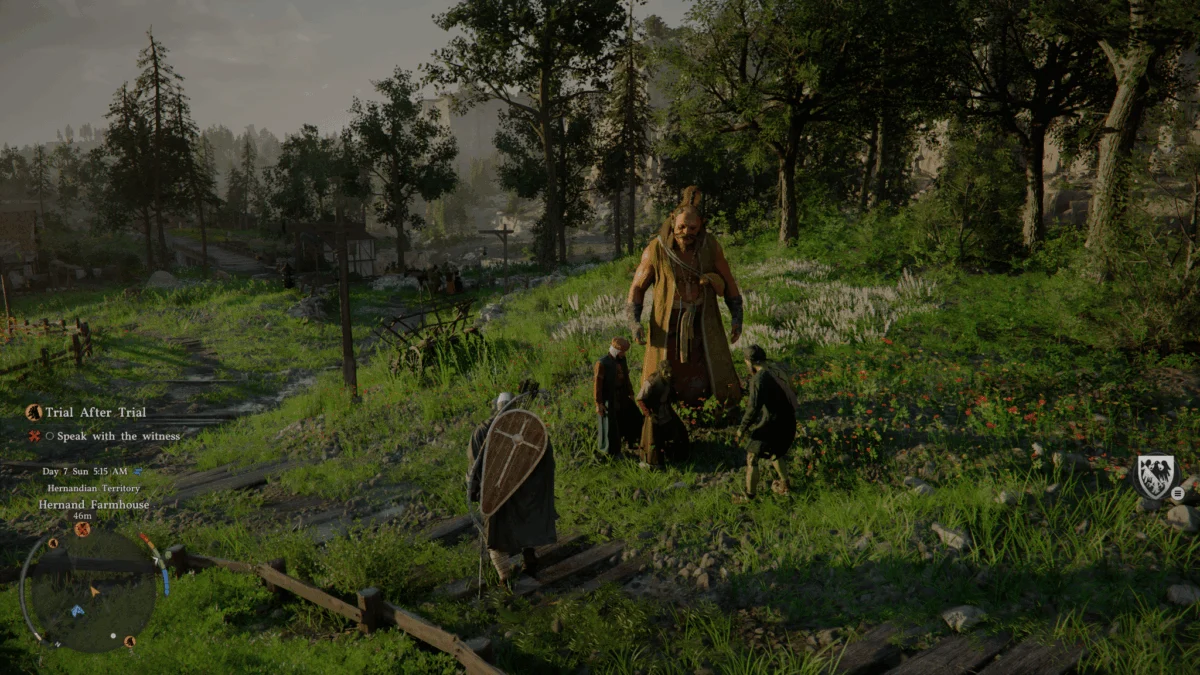
The Narrative Landscape of Pywell and the Greymane Saga
The story of Crimson Desert centers on themes of displacement, leadership, and survival. As Kliff, players must traverse the diverse provinces of Pywell, starting in the western region of Hernand and eventually reaching the titular red sands of the northeast. While the central campaign focuses on the reclamation of the Greymanes’ home and the gathering of lost allies, the narrative is supported by hundreds of faction quests and environmental challenges.

Despite the epic scale of the setting, the narrative structure has been described as a "yin and yang" of quality. The world-building is immersive, featuring distinct cultures ranging from the Scottish-coded Greymanes to the English-inspired nobility and the rough-hewn Orcs of the southern bogs. However, the plot often relies on "the power of the cutscene," where internal logic is sometimes sacrificed for cinematic flair. Characters may display god-like abilities, such as teleportation, during cinematics, only to be constrained by standard combat mechanics once gameplay resumes. This discrepancy occasionally results in frustrating story beats, such as "forced losses" where players deplete multiple boss health bars only for the antagonist to escape during a scripted event.

Technical Analysis of the Blackspace Engine
A significant pillar of Crimson Desert’s identity is the proprietary Blackspace Engine. This technology facilitates a level of visual fidelity that positions the game at the forefront of the current console and PC generation. The engine excels in lighting, draw distance, and physics-based environmental interactions.

On high-end PC hardware, such as the AMD Radeon 7900XTX paired with a Ryzen 5800x, the game is capable of maintaining an average of 85 frames per second at 4K Ultra settings using FSR 3.1.5. Performance on portable Windows-based handhelds is also notable; devices like the ASUS ROG Ally X can run the title at 900p (upscaled to 1080p via Radeon Super Resolution) on low-to-medium settings while maintaining fluid playability. This cross-hardware optimization is a testament to Pearl Abyss’s experience in maintaining large-scale digital environments.

The game features a brief shader compilation process upon the first boot, which effectively eliminates mid-game hitching even when the player is moving at high speeds through dense forests or snowy peaks. The lighting system, in particular, has been lauded for its realism, accurately depicting the humid boglands of the south and the harsh, reflective surfaces of the northern snowfields.

Systems-Focused Gameplay and the Axiom Force
Crimson Desert distinguishes itself through a "systems-focused" gameplay loop that prioritizes physics and player agency over traditional quest markers. Central to this is the "Axiom Force," a magical ability manifested through a gauntlet that allows Kliff to manipulate the environment using energy-based tethers. This mechanic is utilized for traversal, puzzle-solving, and combat.

The game’s approach to movement is heavily influenced by momentum and physics. Kliff can climb nearly any surface, a mechanic reminiscent of recent entries in The Legend of Zelda series, though it is governed by a strict stamina system. Early in the game, players unlock a magical set of wings that allow for hovering and aerial rolling, further expanding the verticality of the world. However, the implementation of these controls on a standard gamepad has been a point of contention among early reviewers, as the "double jump" and "hover" functions are mapped to the same button, occasionally leading to unintended inputs during platforming sequences.

Combat Mechanics: From Hack-and-Slash to Professional Wrestling
The combat in Crimson Desert is a deep, melee-focused system that rewards experimentation and skill acquisition. Players utilize a combination of quick hits to build "Spirit" and heavy attacks that consume stamina. As Kliff encounters various enemies, he can learn new skills simply by observing them in action, a feature that supplements the traditional skill tree progression.

What sets the combat apart is the inclusion of grappling and wrestling maneuvers. By utilizing specific button combinations, players can perform Diamond Cutters, German Suplexes, and running lariats. Enemies can be picked up and thrown off cliffs or into bodies of water, leveraging the game’s physics engine. The "Spirit" meter powers advanced magical abilities, such as the Focus Palm—a strike used to extend enemy stun durations—and a "Trance" mode that slows time, allowing Kliff to catch and redirect incoming projectiles.

Economic Management and Resource Grinding
The progression in Crimson Desert is inextricably linked to its complex economy and resource-gathering systems. Unlike many modern RPGs that utilize a standard leveling system, Kliff’s power is largely determined by "Ancient Artifacts" found in the world and the quality of his gear.

Upgrading equipment requires a significant investment of time in resource gathering. The physics engine is integrated into these tasks; for example, woodcutting involves striking a tree, using magic to lift the fallen trunk, and slamming it into the ground to break it into logs. However, the yield is intentionally low, requiring players to harvest dozens of trees for a single gear upgrade. Mining functions similarly, with players needing to strike specific deposits on cliff faces, sometimes while climbing.

The game also features a robust camp management system. As the Greymanes are reunited, they can be assigned to various tasks, such as guarding nobles or farming, to generate silver and resources in real-time. This system is essential for surviving the game’s "gear checks"—late-game encounters that are virtually impossible without specific health, stamina, and spirit thresholds.

The Evolution of Game Design: From MMO to Single-Player Epic
The development history of Crimson Desert provides vital context for its current state. Originally announced in 2019 as a prequel to the MMORPG Black Desert Online, Pearl Abyss eventually pivoted to a high-budget single-player experience. This transition is evident in the game’s scale and its reliance on systems that feel like a "single-player MMO."

Throughout the review period, Pearl Abyss demonstrated a high level of responsiveness to technical issues. Early versions of the game lacked a long-term storage system at player camps, forcing Kliff to carry all resources in a shared inventory. Following feedback from a dedicated review Discord server, the developers increased the starting inventory slots and committed to implementing a camp storage system post-launch.

Broader Implications for the Action-RPG Genre
Crimson Desert represents a significant moment for the South Korean gaming industry, showcasing the ability of a domestic developer to produce a "AAA" title that rivals the technical and mechanical depth of Western and Japanese giants. Its uncompromising commitment to systemic gameplay—where fire, wind, weight, and momentum all interact—sets a new benchmark for open-world immersion.

While the game is not without its "warts"—including a narrative that can be difficult to follow and a steep resource grind—it offers a level of rewarding complexity rarely seen in the genre. The inclusion of diverse activities such as horse racing, arena brawling, and a merchant guild trading system ensures that players have content to explore long after the 110-hour campaign concludes.

As Crimson Desert moves into its post-launch phase, the focus will remain on Pearl Abyss’s ability to refine the user interface and address remaining bugs. If the developer continues its current trajectory of rapid updates and technical refinement, Crimson Desert is poised to be remembered as a landmark achievement in systems-driven game design, proving that a "simulate everything" approach can result in a deeply engaging, if occasionally overwhelming, experience. For players willing to invest the time to master its obtuse systems, the world of Pywell offers an unparalleled journey of discovery and visceral combat.