


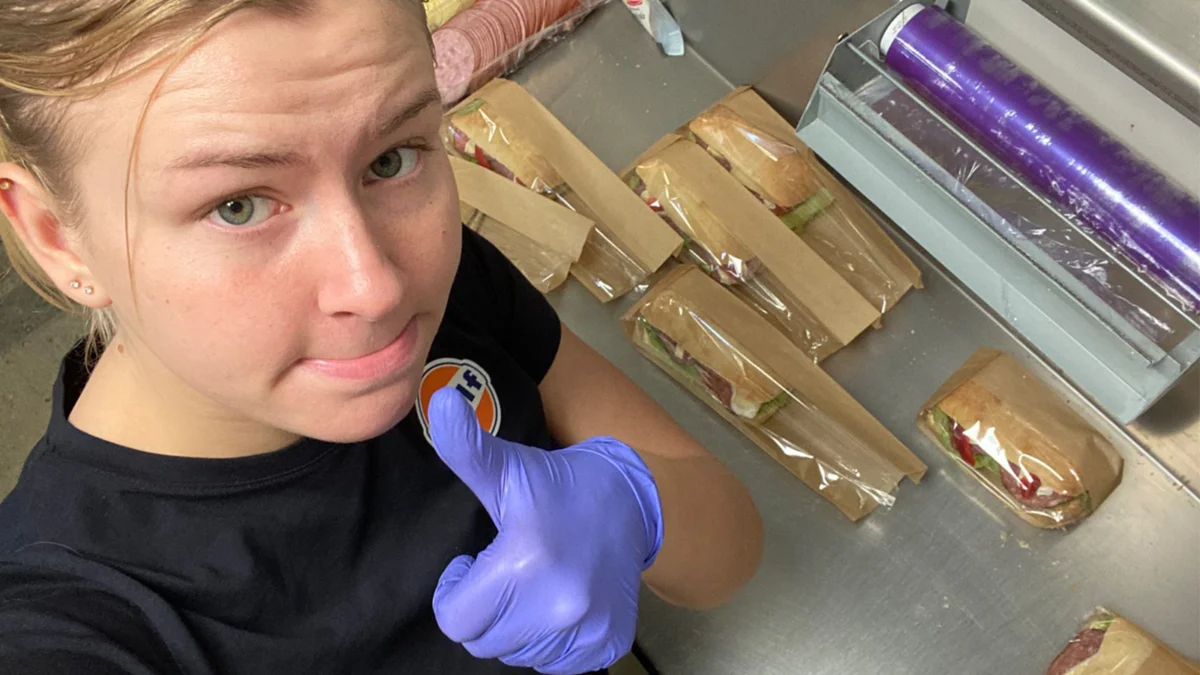
In a move that has resonated deeply within the gaming community and beyond, Swedish Counter-Strike 2 player and commentator Tilde "7liciousCSGO" Byström has become a viral sensation. Her meteoric rise to online fame was sparked by a seemingly simple photograph posted on X (formerly Twitter) on November 19, depicting her in her day job as a sandwich maker. The image, accompanied by the caption, "After 10 years in esports, I’m officially a sandwich maker," has ignited conversations about the precarious financial landscape of professional esports, particularly for women in the scene.
The photograph itself captured Byström offering a cheerful thumbs-up to the camera, her workstation laden with meticulously prepared sandwiches neatly packaged in brown paper bags. This visual narrative served as a poignant and humorous commentary on the realities faced by many in the esports industry. Despite her decade-long dedication to Counter-Strike 2, her experience as a professional player, and her role as a commentator, Byström’s post underscored the common necessity of maintaining a conventional 9-to-5 job to ensure financial stability and cover living expenses.
The impact of Byström’s post was immediate and profound. Within a mere 24 hours, her tweet garnered an astonishing over 300,000 likes and amassed over 18 million views, solidifying its status as a significant online moment. The widespread attention even extended to major commercial entities, with the American fast-food chain Pizza Hut engaging with Byström by commenting, "Pizza maker is also fire." Byström’s witty reply, "YO! I know how to make a pizza," further amplified the lighthearted yet impactful exchange.
The Genesis of a Viral Moment: More Than Just a Sandwich
Speaking exclusively to Dexerto on November 20, Byström elaborated on the multifaceted meaning behind her viral photograph. She revealed that the post was intentionally crafted as a dual-purpose statement: a lighthearted retort to the pervasive misogynistic taunts she, like many female gamers, has encountered, and a stark, yet still playful, illustration of the current economic challenges confronting women’s Counter-Strike 2.
The context of her statement is crucial. The esports industry, particularly for competitive titles like Counter-Strike, has witnessed a growing trend of organizations scaling back or completely dissolving their women’s rosters. A prime example is the recent cessation of operations for ESL Impact, one of Counter-Strike 2’s most prominent women’s circuits. Following its eighth season in October, ESL cited the "current economic model is simply not sustainable" as the primary reason for its discontinuation. This development echoes a broader industry sentiment, as several major Counter-Strike teams, including NAVI, have similarly disbanded their female rosters. NAVI’s rationale for their withdrawal from women’s CS2 was that the business model "seems unsustainable and does not allow for long-term planning."
Byström’s explanation sheds further light on the deeply personal and professional implications of these industry shifts. "The post was actually meant as a joke, because as a gamer, I’ve heard, ‘Go back to the kitchen and make me a sandwich,’ like a million times," she candidly shared. This common insult, hurled at women in gaming spaces, has been weaponized to dismiss their skills and passion.
However, Byström emphasized that the humor was grounded in a tangible reality. "But it is also true that I work by literally making sandwiches from 5 – 10 AM most mornings," she confirmed. "It’s a combination of a joke, but at the same time, to be able to survive and pay rent and still play CS2, especially in the current state of the scene for women’s CS, I have to also work a normal job, and pretty much always had to have side jobs while pursuing my dream!" This statement directly addresses the economic pressure that forces talented players to juggle demanding careers with their esports aspirations.
A Decade in Esports: A Journey of Dedication and Disruption
Byström’s journey in esports is not a nascent one. Her decade-long immersion in the Counter-Strike scene has seen her compete under the banners of several respected esports organizations, including Evil Geniuses Gold and Ghost Gaming. Despite these high-profile affiliations, the financial remuneration offered has consistently fallen short of providing a sustainable full-time income. This reality is a common thread for many aspiring professional gamers who do not reach the absolute elite tier of earnings.
Her commitment to the game began to intensify around 2015 when she started streaming, a platform that allowed her to build a community and hone her skills. By 2019, her focus shifted more rigorously towards the professional aspect of Counter-Strike, aiming to compete at the highest level. However, the lack of stable, full-time salaries from organizations has necessitated a continuous reliance on side jobs and freelance work.
The Evolving Landscape of Women’s Counter-Strike
The economic headwinds affecting women’s esports are not unique to Byström’s experience. Data from various esports industry reports consistently highlights a disparity in investment and revenue generation between men’s and women’s circuits. While the overall esports market has experienced significant growth, projected to reach over $2 billion in revenue by 2024, the distribution of this wealth remains uneven. Sponsorships, prize pools, and team salaries in women’s esports often lag considerably behind their male counterparts.
The dissolution of leagues like ESL Impact and the withdrawal of major organizations from women’s CS2 rosters are symptomatic of a larger debate within the industry: the long-term viability of separate, exclusively female leagues versus the potential for integrated, mixed-gender competition. While some argue that dedicated women’s leagues are crucial for providing platforms and opportunities, others contend that a fully integrated ecosystem would foster greater competition, broader appeal, and potentially more sustainable financial models.
Byström’s Vision: A Future of Mixed Leagues
Despite the current challenges, Byström remains optimistic about the future of women’s Counter-Strike. Her ultimate aspiration is to witness the evolution of the esport to a point where mixed leagues, featuring both male and female players, become a reality. This vision signifies a desire for a more inclusive and meritocratic competitive environment, where talent and skill are the primary determinants of success, irrespective of gender.
"I’ve been playing full-time in Evil Geniuses. I’ve also been in other organizations and getting a salary, but not any that is covered for full-time," Byström reiterated. "The dream for me is that women’s CS can evolve so much that we can, in the future, have mixed teams!" This forward-looking perspective underscores her dedication not only to her personal career but also to the broader advancement of the competitive gaming landscape.
Byström’s viral moment, born from a humble sandwich-making photo, has unexpectedly become a powerful advocacy tool. It has amplified the voices of countless individuals within the esports community who are grappling with similar financial precarity. Her story serves as a compelling reminder that behind the glitz and glamour of professional gaming, dedicated athletes often face significant hurdles, requiring resilience, adaptability, and a persistent pursuit of their passion, even when it means balancing the virtual battlefield with the realities of a daily job. The conversation initiated by her post is likely to persist, pushing for greater transparency, fairer compensation, and a more sustainable future for esports across all its facets.