


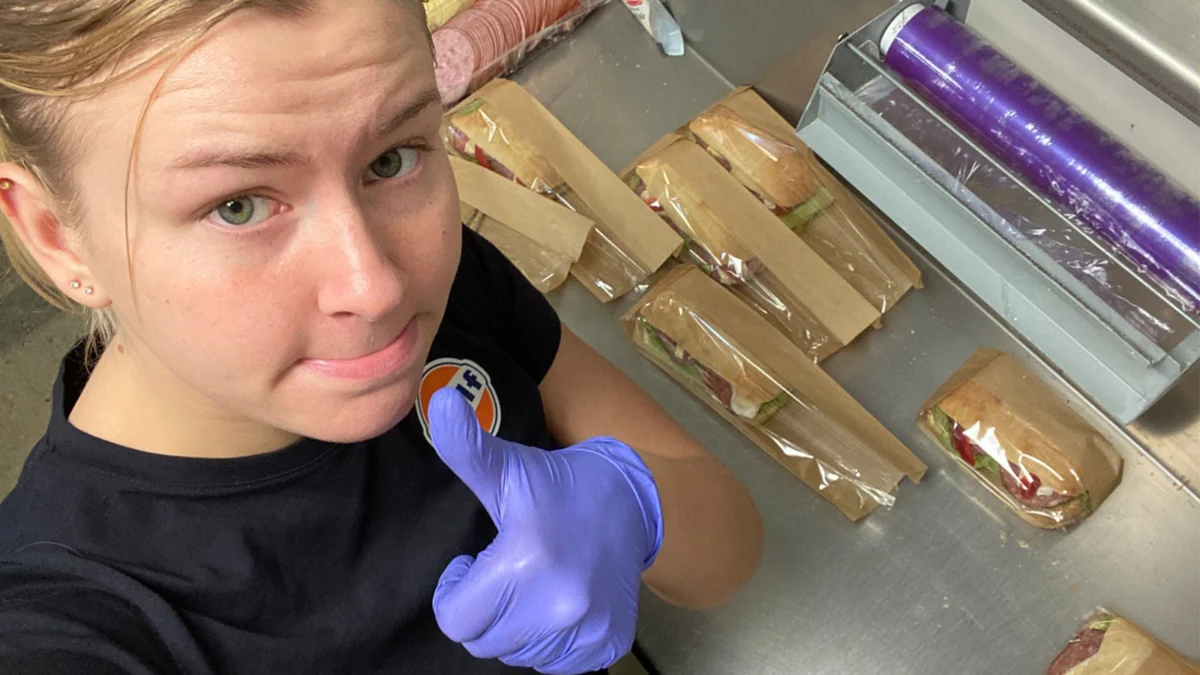
Swedish Counter-Strike 2 (CS2) professional player and commentator Tilde "7liciousCSGO" Byström has ignited a significant online conversation, reaching viral status after posting a photograph of herself at her day job, meticulously preparing sandwiches. The image, shared on the social media platform X (formerly Twitter) on November 19, 2025, was accompanied by a caption that succinctly captured her situation: "After 10 years in esports, I’m officially a sandwich maker."
The photograph depicted Byström with a confident, yet playful, thumbs-up gesture directed at the camera. Behind her, her workstation was laden with an array of sandwiches, neatly assembled and packaged in brown paper bags, ready for distribution. This seemingly simple post served as a poignant and often humorous commentary on the precarious financial landscape of the esports industry. Despite her decade of dedication to Counter-Strike, including her expertise as a professional player and her role as a commentator, Byström’s post underscored the stark reality that many in the esports world, particularly women, must maintain traditional employment to sustain themselves financially.
The viral nature of the post was swift and profound. Within a span of less than 24 hours, Byström’s tweet garnered an impressive surplus of 300,000 likes and amassed over 18 million views, demonstrating the widespread resonance of her message. The post even captured the attention of major industry players, including the American fast-food chain Pizza Hut, which offered a playful acknowledgment: "Pizza maker is also fire." Byström responded with equal enthusiasm, humorously stating, "YO! I know how to make a pizza."
The Genesis of a Viral Moment: A Dual-Layered Commentary
In an exclusive interview conducted on November 20, 2025, Byström elaborated on the multifaceted meaning behind her viral sandwich-making photograph. She revealed that the post was intentionally crafted as a dual-purpose statement: a lighthearted retort to the prevalent sexist taunts she and other female gamers have endured, and a sharp, albeit humorous, observation on the current economic climate within professional women’s CS2.
The phrase "Go back to the kitchen and make me a sandwich" has long been a derogatory and dismissive remark hurled at women in gaming communities, reflecting a deeply ingrained misogyny that questions their legitimacy and dedication to competitive play. Byström’s image directly confronts this stereotype by literally embodying the action, transforming a slur into a symbol of her resilience and the necessity of her current employment.
"The post was actually meant as a joke, because as a gamer, I’ve heard, ‘Go back to the kitchen and make me a sandwich,’ like a million times," Byström explained. "But it is also true that I work by literally making sandwiches from 5 – 10 AM most mornings. It’s a combination of a joke, but at the same time, to be able to survive and pay rent and still play CS2, especially in the current state of the scene for women’s CS, I have to also work a normal job, and pretty much always had to have side jobs while pursuing my dream!"
This candid explanation highlights the dual pressures faced by aspiring and established female esports professionals: the relentless pursuit of excellence in a highly competitive field, coupled with the constant struggle for financial stability in an industry that has historically underfunded and undervalued women’s leagues and rosters.
The Bleak Economic Reality of Women’s Esports
Byström’s commentary is situated against a backdrop of concerning trends within the professional women’s Counter-Strike circuit. The esports industry, while experiencing overall growth, has seen a significant contraction in investment and support for women’s divisions in recent years. This has led to the dissolution of several prominent leagues and team rosters, creating a climate of uncertainty for female players.
A key example of this downturn is the cessation of operations for ESL Impact, one of Counter-Strike’s premier women’s circuits. After its eighth season concluded in October 2025, ESL cited the "current economic model is simply not sustainable" as the primary reason for its discontinuation. This decision sent ripples of concern throughout the community, signaling a potential reduction in competitive opportunities and prize pools.
Furthermore, numerous high-profile Counter-Strike organizations have progressively disbanded their women’s rosters. Natus Vincere (NAVI), a prominent esports organization, publicly stated that the business model for their women’s CS2 group "seems unsustainable and does not allow for long-term planning." Such pronouncements from major teams underscore a systemic issue of financial viability and long-term commitment within the women’s esports ecosystem.
The implications of these developments are far-reaching. Players like Byström, who have dedicated years to honing their skills and contributing to the growth of women’s esports, are left with diminished avenues for professional advancement and financial reward. The reliance on side jobs, as exemplified by Byström’s sandwich-making, becomes not just a personal choice but a widespread necessity for survival within the competitive landscape.
A Career Forged in Competition and Commentary
Byström’s journey in esports is not a nascent one. She has a notable history of competing under the banners of reputable organizations such as Evil Geniuses Gold and Ghost Gaming. While these affiliations provided valuable experience and exposure, they have, by her own admission, not translated into the kind of full-time salary that allows for complete financial independence.
Her involvement in esports began with streaming in 2015, and she shifted her focus towards the professional aspect of the game in 2019. This decade-long commitment to Counter-Strike, encompassing both playing and casting, highlights a deep-seated passion and expertise that is unfortunately not always commensurately rewarded financially.
The challenge for players like Byström lies in the disparity between the dedication and skill required for professional esports and the available compensation. While the esports industry as a whole generates billions of dollars annually, the distribution of this wealth has historically favored established male leagues and teams, leaving significant gaps in funding and support for emerging or niche sectors, such as women’s esports.
The Ultimate Aspiration: Mixed-League Play
Despite the current financial headwinds and the frustrating realities of the industry, Byström holds onto a vision for the future of women’s Counter-Strike. Her ultimate aspiration is to see the esport evolve to a point where mixed-gender leagues become a reality. This would not only offer more competitive opportunities but also foster a more inclusive and integrated esports environment.
"I’ve been playing full-time in Evil Geniuses. I’ve also been in other organizations and getting a salary, but not any that is covered for full-time," Byström stated, reflecting on her career. "The dream for me is that women’s CS can evolve so much that we can, in the future, have mixed teams!"
The concept of mixed-gender professional esports leagues is a subject of ongoing debate. Proponents argue that it would foster greater equality, showcase diverse talent, and potentially attract a broader audience. Critics often raise concerns about competitive balance and the distinct player development pathways that have emerged in men’s and women’s leagues. However, for players like Byström, it represents a progressive step towards a more equitable and unified future for the game.
Broader Implications and Future Outlook
Tilde "7liciousCSGO" Byström’s viral moment serves as a potent reminder of the ongoing struggles faced by many in the esports industry, particularly women. Her relatable and honest portrayal of balancing a passion for competitive gaming with the necessity of a conventional job has struck a chord with a vast audience, transcending the immediate confines of the esports community.
The implications of her post extend beyond individual financial hardship. It shines a spotlight on the critical need for increased investment, more sustainable business models, and a fundamental shift in societal attitudes towards women in gaming and esports. The success of Byström’s tweet underscores a collective desire for a more equitable and supportive environment where talent and dedication are the primary determinants of success, not gender.
As the esports landscape continues to evolve, the conversation initiated by Byström’s sandwich-making photo is likely to persist. It compels stakeholders—organizers, teams, sponsors, and the wider gaming community—to critically examine the current state of women’s esports and to actively work towards solutions that ensure its long-term viability and growth. The dream of professional gamers being able to solely focus on their craft, without the constant pressure of securing basic financial stability through side jobs, remains a vital objective for the future of competitive gaming.